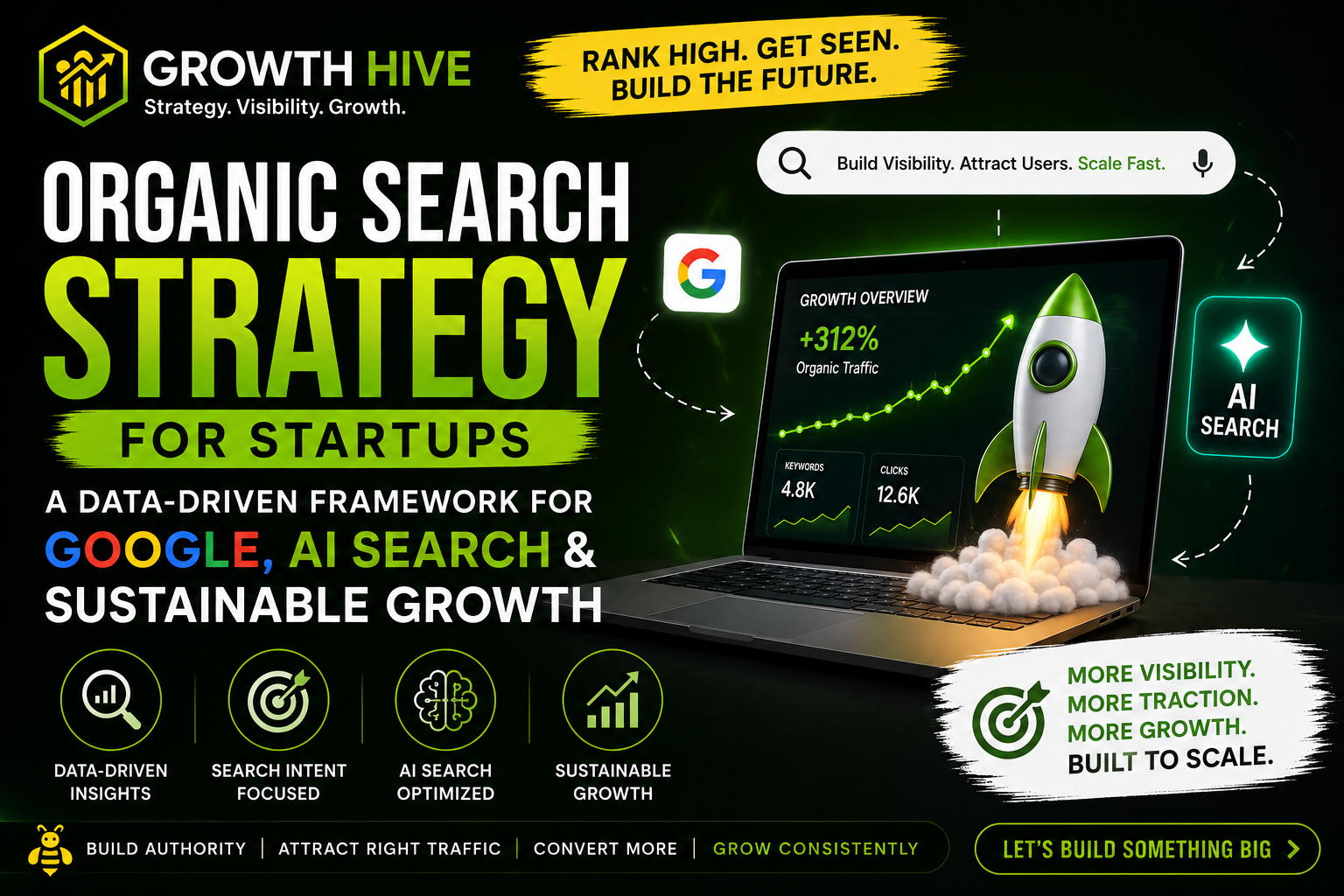

Your product could be the best in your category and still lose every single buyer search — because nobody typed your brand name into Google, they typed the problem you solve, and a competitor answered first. That's the entire risk of skipping an organic search strategy for startups: you can build something great and still be invisible where 90%+ of buying journeys now start. This guide breaks down exactly what an organic search strategy for startups looks like when it's built to compound, not just to "post more blogs."
What Is an Organic Search Strategy for Startups?
An organic search strategy for startups is a structured, unpaid plan to earn visibility on Google, AI Overviews, and answer engines like ChatGPT and Perplexity — built around technical health, keyword and intent mapping, content that answers real buyer questions, and authority signals like backlinks. Unlike a single SEO tactic (say, publishing blog posts), a true organic search strategy for startups treats technical SEO, content, and authority-building as one connected system, sequenced so early wins fund later, harder wins. Most founders see first Search Console movement in 3–5 weeks, with compounding gains by day 90 — that's the realistic timeline for a well-sequenced organic search strategy for startups, not the "SEO takes 6 months, trust me" line agencies use to avoid accountability.
Why Most Founders Get Their Organic Search Strategy for Startups Wrong
Founders usually approach organic search strategy for startups in one of three broken ways:
- The "blog and pray" approach — publishing content with no keyword or intent mapping behind it, hoping volume alone moves rankings.
- The freelancer-hop approach — hiring a new freelancer every quarter, which resets any organic search strategy for startups back to zero because there's no continuity in technical fixes or link equity.
- The paid-ads-only approach — treating organic as "something to figure out later," which means every dollar of growth stops the moment ad spend stops.
None of these are actually a strategy — they're activity. A real organic search strategy for startups needs sequencing: technical foundation first, then intent-mapped content, then authority. Skip a phase and the others underperform.
The 6-Phase Advanced SEO Framework™: A Real Organic Search Strategy for Startups
This is the exact organic search strategy for startups Growth Hive runs for its client base, built by a senior squad — strategist, content engineer, technical SEO specialist, and link builder — instead of a single generalist juggling everything.
Phase 1 — Deep Technical Audit. Before any organic search strategy for startups can work, the site has to be crawlable, fast, and indexable. This phase covers Core Web Vitals, crawl budget, site architecture, and mobile performance.
Phase 2 — Keyword & Intent Mapping. Every keyword is mapped to buyer intent — informational, commercial, or transactional — so content matches where the visitor actually is in their decision.
Phase 3 — Content Engineering. Content is AI-drafted from keyword and SERP-gap research, then fully human-edited for accuracy, voice, and E-E-A-T before publishing — this is where an organic search strategy for startups either becomes genuinely useful or becomes noise.
Phase 4 — Authority Link Building. White-hat, topically relevant backlink building — not spray-and-pray link farms — builds the trust signals that let content actually rank once it's live.
Phase 5 — Tracking & Reporting. A real-time ranking and traffic dashboard with weekly reporting replaces vague monthly PDFs, so founders can see exactly what's moving inside their organic search strategy for startups.
Phase 6 — Conversion Optimization. Traffic without conversion isn't a strategy — this phase makes sure the pages ranking are also the pages converting.
Comparison Table: DIY vs. Freelancer vs. Agency-Led Organic Search Strategy for Startups
| Approach | Speed to Results | Technical Depth | Consistency | Cost Predictability |
|---|---|---|---|---|
| DIY (founder-led) | Slowest — competes with running the business | Low, unless founder has SEO background | Inconsistent, deprioritized during busy periods | High effort, low cash cost |
| Freelancer | Moderate, but resets with turnover | Varies widely by individual | Fragile — one person, one skillset | Cheaper per hour, expensive in lost continuity |
| Agency-led (senior squad) | Fastest structured path — first movement in 3–5 weeks | High — dedicated technical, content, and link specialists | Consistent, framework-driven | Flat monthly retainer, easier to forecast |
An agency-led organic search strategy for startups isn't automatically the right call for every stage — pre-seed founders with near-zero content budget may need to start DIY. But once there's product-market fit and a real acquisition budget, the agency model is what turns organic search strategy for startups from a side project into a predictable revenue channel.
How to Evaluate an Agency for Your Organic Search Strategy for Startups (Checklist)
Before handing your organic search strategy for startups to any agency, check for:
- A written guarantee — page 1/top 10 rankings within a stated window (30–90 days), or a refund. No guarantee, no accountability.
- No long-term lock-in — month-to-month terms with a short cancellation notice, and you keep all delivered work either way.
- Real-time reporting access — a live dashboard, not a static PDF emailed once a month.
- A named, reachable strategist — not a rotating support inbox.
- Transparent content process — ask exactly how content is researched, drafted, and edited before publishing.
- Evidence over promises — verifiable client counts, review ratings, and real backlink profile examples, not vague "we've helped hundreds of clients" claims with no source.
Myths & Misconceptions About Organic Search Strategy for Startups
Myth 1: "SEO is slow, so it's not worth it for an early-stage startup." This misconception exists because most SEO efforts are unstructured, so results genuinely do take longer. A sequenced organic search strategy for startups shows measurable Search Console movement within weeks — the slowness people experience is usually a symptom of skipping the technical and intent-mapping phases, not a property of organic search itself.
Myth 2: "More blog posts always means more traffic." This fails because unmapped content competes with itself (keyword cannibalization) or targets keywords with no real buyer intent behind them. Volume without a mapped organic search strategy for startups just produces noise.
Myth 3: "Once we rank, we're done." Rankings decay without maintenance — competitors publish, algorithms update, and technical issues creep back in. An organic search strategy for startups is a maintained system, not a one-time project.
Case Study: Applying the Framework
A Series A SaaS startup came to Growth Hive with strong product traction but almost zero organic visibility outside branded search — a classic "great product, invisible in search" scenario. The technical audit (Phase 1) surfaced a crawl budget issue caused by thousands of low-value filtered URLs competing with core product pages. Once resolved, Phase 2's intent mapping revealed the team had been writing exclusively top-of-funnel educational content while ignoring high-intent comparison and pricing-page searches. Content engineering (Phase 3) rebalanced the mix toward those commercial-intent pages, and authority link building (Phase 4) targeted industry-relevant sites rather than generic guest-post networks. Within the first reporting cycle, the startup saw its first non-branded page-1 rankings on mid-funnel commercial keywords, with compounding movement continuing through the next two quarters — the kind of trajectory a genuinely sequenced organic search strategy for startups is built to produce.
FAQs
How long does an organic search strategy for startups take to show results?
Most founders see first Search Console movement — impressions and initial ranking shifts — in 3–5 weeks, with compounding gains by around day 90. Full page-1 rankings on competitive terms typically build over 2–3 quarters.
Do startups need SEO if they're already running paid ads?
Yes — paid ads stop producing traffic the moment spend stops, while an organic search strategy for startups compounds over time and lowers blended customer acquisition cost as rankings mature.
What's the difference between SEO and an organic search strategy for startups specifically?
"SEO" often refers to individual tactics; an organic search strategy for startups sequences technical fixes, intent-mapped content, and authority-building into one system tailored to a startup's stage, budget, and growth goals.
Can a startup do organic search strategy in-house without an agency?
Yes, especially pre-revenue, but it requires technical SEO, content, and link-building skills rarely found in one generalist hire — which is why most startups bring in outside expertise once there's budget to move faster.
How much does an organic search strategy for startups typically cost?
Costs vary by scope, competition, and content volume — agencies should break down what's included versus extra, and any offer with no written performance guarantee is worth questioning.
How does AI search (ChatGPT, AI Overviews) change organic search strategy for startups?
Content now needs to be structured for extraction — clear definitions, direct answers, and comparison tables — since generative engines pull complete, standalone answers rather than just ranking blue links.
Key Takeaways
- An organic search strategy for startups only works when technical health, intent-mapped content, and authority-building are sequenced together, not run as separate efforts.
- First Search Console movement typically shows in 3–5 weeks under a structured framework, with compounding results by day 90.
- DIY, freelancer, and agency-led paths each fit different startup stages — the right choice depends on budget and speed needed.
- Content volume without intent mapping causes keyword cannibalization, not growth.
- A written guarantee, month-to-month terms, and real-time reporting are the minimum bar when evaluating an agency partner.
- Organic search strategy for startups must now account for AI Overviews and answer engines, not just traditional Google rankings.
Conclusion
A great product with no organic search strategy for startups behind it is still invisible to the buyers actively searching for a solution today. The founders who win this channel aren't the ones publishing the most content — they're the ones running a sequenced system: technical foundation, mapped intent, engineered content, real authority, and honest reporting. Book Your Free Call and Growth Hive's senior squad will map out exactly where your organic search strategy for startups stands today and what the next 90 days should look like — backed by a written page 1/top 10 guarantee.