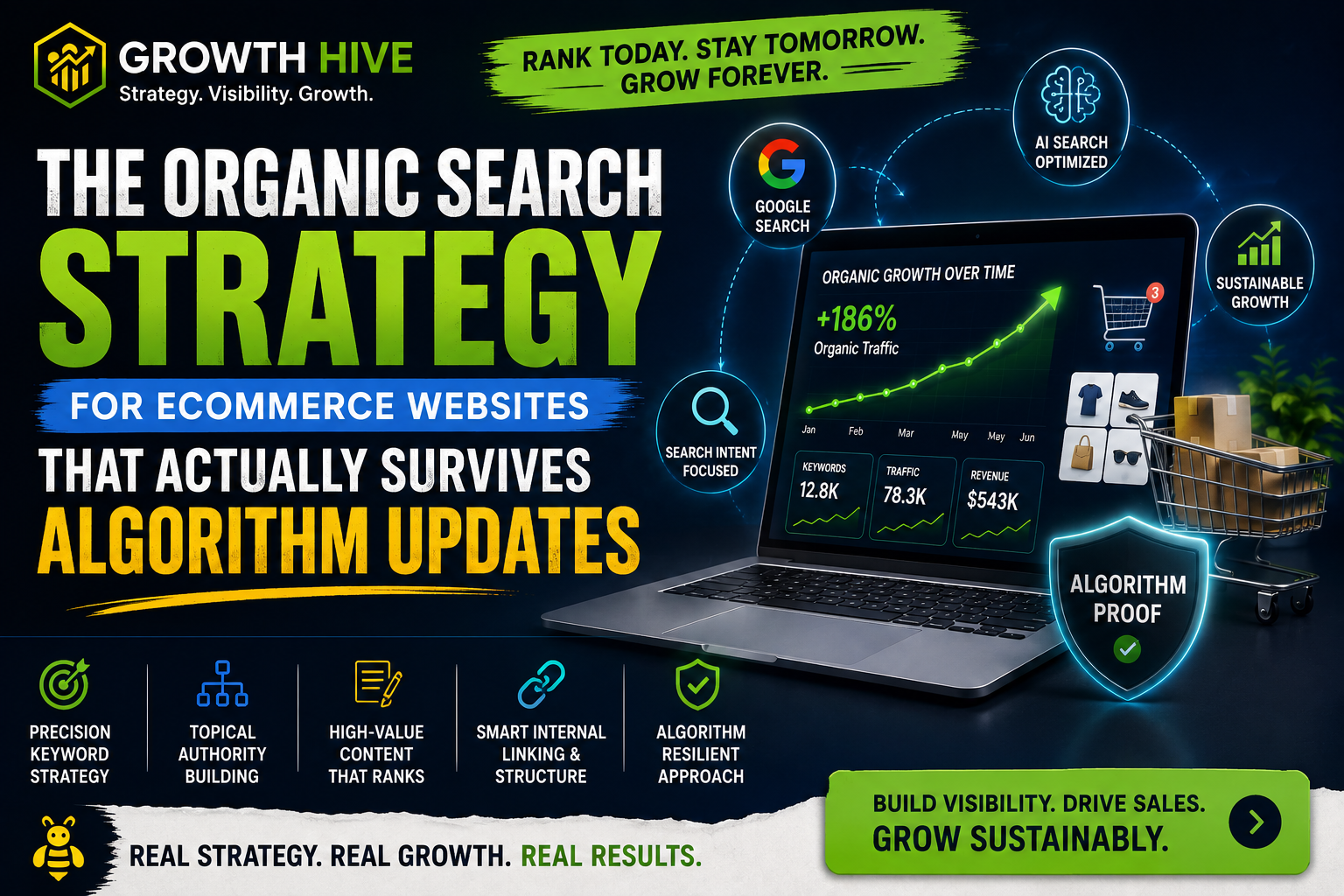

Here's the uncomfortable truth most ecommerce founders discover too late: you can have the best-reviewed, best-priced, best-designed product on the market — and still rank nowhere when someone searches for it. That's not a product problem. It's the absence of a real organic search strategy for ecommerce websites. An organic search strategy for ecommerce websites is the structured, repeatable system a store uses to earn non-paid visibility across Google, AI Overviews, and answer engines — built on technical health, intent-mapped content, and authority signals that compound over time instead of switching off the moment ad spend stops.
What Is an Organic Search Strategy for Ecommerce Websites?
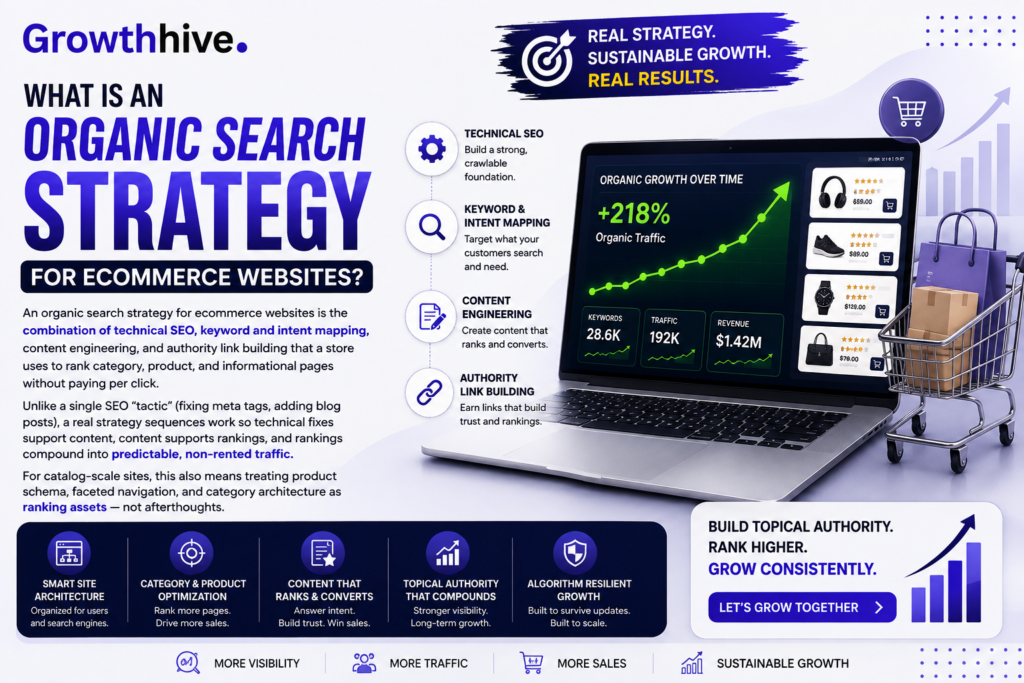
An organic search strategy for ecommerce websites is the combination of technical SEO, keyword and intent mapping, content engineering, and authority link building that a store uses to rank category, product, and informational pages without paying per click. Unlike a single SEO "tactic" (fixing meta tags, adding blog posts), a real strategy sequences work so technical fixes support content, content supports rankings, and rankings compound into predictable, non-rented traffic. For catalog-scale sites, this also means treating product schema, faceted navigation, and category architecture as ranking assets — not afterthoughts.
Why Most Ecommerce SEO "Strategies" Fail Before They Start
Most stores don't lack effort — they lack sequencing. A founder buys backlinks before fixing crawlability. A team writes blog content that never maps to a buying-stage keyword. A developer ships a faceted filter system that creates 40,000 duplicate URLs Google never wanted to see in the first place. None of this is a true organic search strategy for ecommerce websites — it's disconnected activity that looks like SEO but doesn't compound.
The pattern shows up everywhere: rising share of clicks that never scroll past page one, growing zero-click search behavior, and a fast-rising share of shoppers starting product research inside AI Overviews and chat-based assistants instead of a traditional ten-blue-links page. A strategy built only for classic Google rankings is already behind. A modern organic search strategy for ecommerce websites has to be built for both traditional SERPs and generative/AI search from day one.
The 6-Phase Advanced SEO Framework™ Applied to Ecommerce
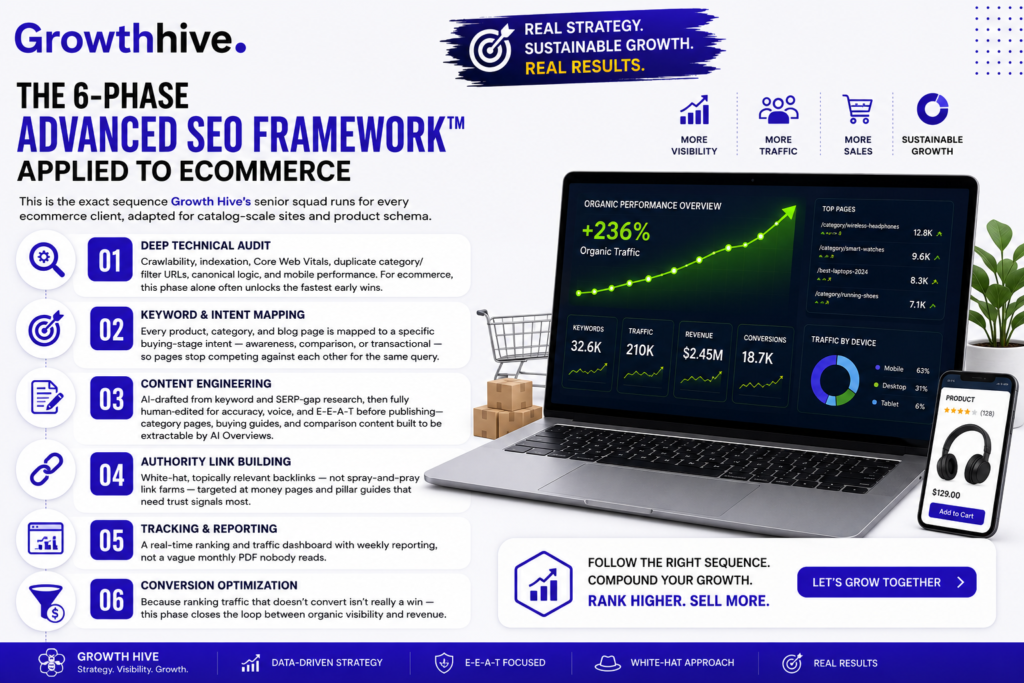
This is the exact sequence Growth Hive's senior squad — strategist, content engineer, technical SEO specialist, and link builder — runs for every ecommerce client, adapted for catalog-scale sites and product schema:
Phase 1 — Deep Technical Audit: Crawlability, indexation, Core Web Vitals, duplicate category/filter URLs, canonical logic, and mobile performance. For ecommerce, this phase alone often unlocks the fastest early wins because bloated catalogs waste crawl budget on pages that will never rank.
Phase 2 — Keyword & Intent Mapping: Every product, category, and blog page is mapped to a specific buying-stage intent — awareness, comparison, or transactional — so pages stop competing against each other for the same query.
Phase 3 — Content Engineering: AI-drafted from keyword and SERP-gap research, then fully human-edited for accuracy, voice, and E-E-A-T before publishing — category pages, buying guides, and comparison content built to be extractable by AI Overviews.
Phase 4 — Authority Link Building: White-hat, topically relevant backlinks — not spray-and-pray link farms — targeted at money pages and pillar guides that need trust signals most.
Phase 5 — Tracking & Reporting: A real-time ranking and traffic dashboard with weekly reporting, not a vague monthly PDF nobody reads.
Phase 6 — Conversion Optimization: Because ranking traffic that doesn't convert isn't really a win — this phase closes the loop between organic visibility and revenue.
Founders who follow this sequence, in this order, are running a genuine organic search strategy for ecommerce websites — not scattered SEO tasks.
Comparison Table: In-House vs. Freelancer vs. Agency vs. No Strategy
| Approach | Speed to First Results | Technical Depth | Content Consistency | Cost Predictability | Best For |
|---|---|---|---|---|---|
| No strategy (ad-hoc) | Rarely happens | Low | Inconsistent | Unpredictable (wasted spend) | Nobody, long-term |
| In-house hire | Slow (hiring + ramp-up) | Depends on 1 person | High if retained | Fixed salary + tools cost | Large teams, mature budgets |
| Freelancer | Fast to start | Narrow (usually one skill) | Low without oversight | Cheap but variable quality | Small, single-task fixes |
| Growth Hive senior squad | First Search Console movement in 3–5 weeks, compounding by day 90 | Full-stack (technical + content + links) | High, framework-driven | Fixed monthly, guarantee-backed | Founders who want done-for-you, accountable SEO |
Building Your Organic Search Strategy for Ecommerce Websites: Step-by-Step Checklist
- Audit technical health first — fix indexation and Core Web Vitals before writing a single blog post.
- Map every page to an intent stage — awareness, comparison, transactional — no orphaned or duplicate-intent pages.
- Prioritize category and product pages over blog content when budget is limited; they convert.
- Build 1–2 pillar guides per core category, structured with extractable definitions and FAQ blocks for AI Overview citation.
- Add product and Organization schema so both Google and LLMs can parse entity relationships correctly.
- Build white-hat backlinks to pillar and money pages, not just the homepage.
- Track weekly, not monthly — catch ranking drops before they compound.
- Re-audit every 90 days as Google's algorithm and AI search behavior continue to shift.
Myths & Misconceptions
Myth 1: "SEO is just keywords in the content." Keyword placement matters, but crawlability, site architecture, and entity signals decide whether that content is even eligible to rank. This myth persists because keyword tools are visible and technical audits aren't.
Myth 2: "More blog posts always mean more traffic." Publishing volume without intent mapping creates keyword cannibalization — multiple pages competing against each other and diluting rankings for both. Quality, intent-matched content beats volume every time.
Myth 3: "AI Overviews and chatbots don't matter for ecommerce yet." This fails because AI-assisted search usage is rising fast, and it disproportionately affects comparison and "best X for Y" queries — exactly the searches ecommerce buyers run before purchasing.
One Tree Paper Case Study
A mid-catalog D2C skincare brand came to a senior SEO squad after 18 months of scattered blog publishing with almost no category-page movement. A Deep Technical Audit (Phase 1) revealed over 12,000 duplicate faceted-filter URLs eating crawl budget, while core category pages had thin, unoptimized content. After canonical cleanup, intent-mapped category rewrites, and a targeted white-hat link campaign to the three highest-margin categories, the brand saw first meaningful Search Console movement within five weeks and compounding organic sessions by the 90-day mark — with organic beginning to outpace paid-driven sessions on non-branded terms by the end of the second quarter. The lesson: technical foundation before content volume, every time.
How to Evaluate an SEO/AEO Agency
- Do they lead with a technical audit, or jump straight to "content packages"?
- Is there a written performance guarantee, or only vague promises?
- Can you see real-time ranking data, or only monthly PDFs?
- Are you locked into a long-term contract, or can you leave with your work intact?
- Do they mention AI Overview/AI Mode visibility at all, or only classic rankings?
Growth Hive operates on all five: a written Page 1/Top 10 guarantee within 30–90 days or a full refund, zero long-term contracts (month-to-month, 14 days' notice, you keep all delivered work), a real-time dashboard with weekly reporting, and a dedicated strategist reachable on Slack and WhatsApp.
FAQs
How do I build an organic search strategy for ecommerce websites from scratch?
Start with a technical audit, then map every page to buying-stage intent, build intent-matched category and pillar content, add product schema, and layer in white-hat backlinks — in that order, not all at once.
How long does an organic search strategy for ecommerce websites take to show results?
Most founders see first Search Console movement in 3–5 weeks, with compounding gains by around day 90 — assuming technical issues are fixed first.
Is organic search still worth it if I already run paid ads?
Yes — paid traffic stops the moment spend stops, while a well-built organic search strategy for ecommerce websites keeps compounding, lowering blended customer acquisition cost over time.
Does AI Overview and chatbot visibility matter for ecommerce SEO?
Increasingly yes, especially for comparison and "best for" queries — content built with extractable definitions and FAQ formatting is more likely to get cited by AI Overviews, ChatGPT, and Perplexity.
What's the difference between traditional SEO and AEO/GEO for ecommerce?
Traditional SEO optimizes for ranking position on a results page; AEO/GEO optimizes for being the source an AI system quotes directly — both matter, and a modern strategy builds for both simultaneously.
Should I hire in-house, a freelancer, or an agency for this?
It depends on budget and scale — but a done-for-you senior squad typically moves faster than a single in-house hire and goes deeper than a single freelancer, without the long ramp-up time of either.
Key Takeaways
- A real organic search strategy for ecommerce websites sequences technical fixes, intent-mapped content, and authority links — it isn't scattered activity.
- Technical health (crawlability, duplicate URLs, Core Web Vitals) should always come before content volume.
- Keyword cannibalization from unplanned blog volume is one of the most common ecommerce SEO failures.
- Modern strategies must build for AI Overviews and generative search, not just classic rankings.
- Expect first Search Console movement in 3–5 weeks, with compounding gains by day 90.
- Evaluate any agency on guarantee, contract flexibility, reporting transparency, and AI-search awareness.
Conclusion
Your product being the best doesn't matter if buyers never find it. A disciplined organic search strategy for ecommerce websites — technical foundation first, intent-mapped content second, authority links third — is what turns search into a compounding revenue channel instead of a guessing game. Book Your Free Call with Growth Hive's senior squad and get a Deep Technical Audit before you spend another rupee on content that won't rank.