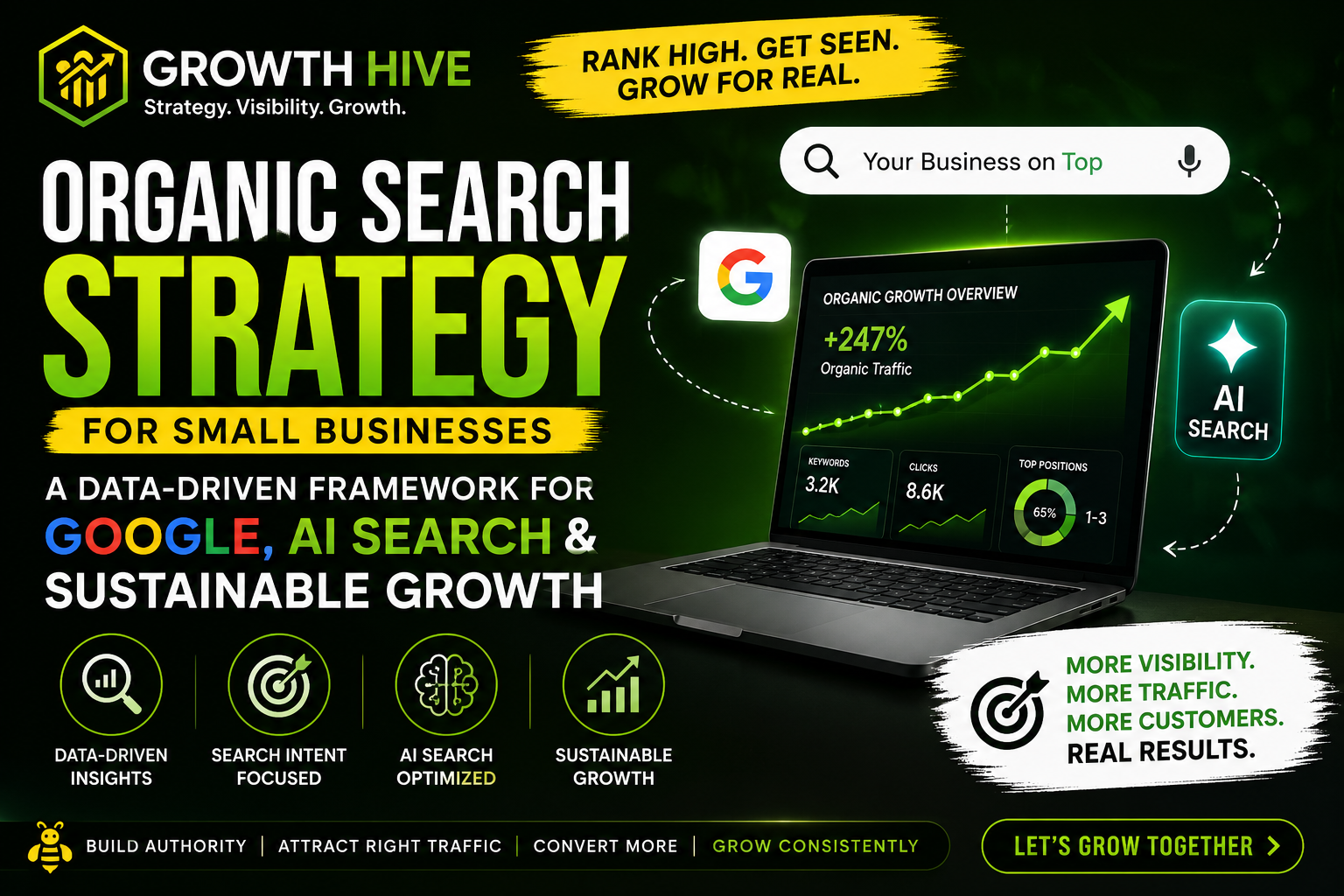

Your product could be the best in your category, and your service could be the most reliable in your city — but if your ideal customers cannot find you when they search, your competitors get the opportunity instead.
That is the quiet failure most small businesses never diagnose.
A strong organic search strategy for small businesses is not simply publishing blog posts, adding keywords, or asking someone to “do SEO.” It is a structured system that connects technical SEO, search intent, content, authority, internal linking, conversion optimization, and increasingly, visibility across AI-powered search experiences.
The objective is simple:
Get discovered by the right people → answer their questions → build trust → earn the click → generate qualified leads and customers.
Unlike paid advertising, organic search can continue producing visibility after individual pieces of work are completed. But sustainable organic growth is not automatic. It requires the right technical foundation, useful content, authority, ongoing optimization, and a strategy aligned with how customers actually search.
For small businesses, that means building an organic search system around business value rather than vanity traffic.
What Is an Organic Search Strategy for Small Businesses?
An organic search strategy for small businesses is a documented, prioritized plan for improving a website's visibility in unpaid search results and turning that visibility into qualified business outcomes.
It connects:
- Technical SEO
- Keyword research
- Search-intent mapping
- Content strategy
- Internal linking
- Topical authority
- Local relevance
- Digital authority
- Conversion optimization
- Performance measurement
- AI-search readiness
The goal is not to rank for as many keywords as possible.
The goal is to become visible for the searches that matter to your ideal customers — particularly the searches that indicate a problem, need, comparison, solution, or buying decision.
A useful organic search strategy therefore follows this path:
Business Goals → Customer Needs → Search Intent → Content → Authority → Visibility → Conversion
That is fundamentally different from publishing content first and hoping traffic follows.
Why Most Small Business Organic Search Strategies Fail
Most small businesses do not fail because SEO does not work.
They fail because SEO activity is disconnected from strategy.
1. The “Post and Pray” Trap
Publishing a blog every week does not automatically create organic growth.
If the website has:
- Indexation problems
- Weak site architecture
- Poor internal linking
- Duplicate or competing pages
- Weak commercial pages
- Thin content
- Poor search intent alignment
then publishing more content can simply increase the amount of content that underperforms.
Content should be created because it solves a specific search or business problem — not because the content calendar says Tuesday is “blog day.”
2. Chasing Search Volume Instead of Buyer Intent
A keyword with 10,000 searches per month can be less valuable than a keyword with 100 searches.
Why?
Because search volume does not tell you whether the searcher is ready to buy.
Compare:
“what is SEO”
with:
“SEO agency for small business”
The first may attract a large informational audience.
The second may attract someone actively evaluating a service provider.
A strong strategy therefore prioritizes:
Intent + Relevance + Business Value + Ranking Feasibility
rather than search volume alone.
3. Creating Pages for Every Keyword Variation
Modern search systems can understand related queries and concepts without requiring a separate page for every wording variation.
Creating dozens or hundreds of near-identical pages simply because different keyword combinations exist can create duplication, cannibalization, thin content, and poor user experiences.
Google's current guidance specifically warns against producing large quantities of pages primarily to manipulate Search or generative AI visibility.
The better approach is:
One strong resource → multiple related questions answered naturally → strong internal connections → genuine usefulness.
The Growth Hive 6-Phase Organic Search Framework™
Our small-business organic search strategy is built around six connected phases.
Phase 1 — Deep Technical SEO Audit
Before scaling content, we establish whether search engines can efficiently access, understand, and index the website.
We examine:
- Crawlability
- Indexation
- Robots directives
- XML sitemaps
- Canonicals
- Internal links
- Site architecture
- Mobile experience
- Page experience
- Core Web Vitals
- Rendering
- Duplicate URLs
- Redirects
- Broken pages
- Orphan pages
- Content accessibility
The objective is not to “fix technical SEO” for the sake of having a checklist completed.
The objective is to remove technical obstacles that prevent important pages from being discovered, understood, indexed, or properly connected.
Phase 2 — Keyword & Search-Intent Mapping
Every commercially important search opportunity should have a purpose.
We classify searches around:
Informational Intent
The user wants to learn.
Examples:
- what is an organic search strategy
- how does SEO work
- how to improve Google rankings
Commercial Intent
The user is evaluating solutions.
Examples:
- best SEO strategy for small business
- small business SEO services
- organic search agency
Transactional Intent
The user is closer to taking action.
Examples:
- hire SEO agency
- SEO consultant for small business
- small business SEO company
Local Intent
The user wants a provider, product, or service in a specific location.
Examples:
- SEO company near me
- small business SEO agency in Austin
- local SEO consultant
Comparison & Decision Intent
The user is evaluating alternatives.
Examples:
- SEO vs Google Ads for small business
- agency vs in-house SEO
- best SEO strategy for a local business
A strong strategy maps these intents to the correct pages instead of forcing one page to rank for everything.
Phase 3 — Content Engineering
Content should be created around search intent, information gain, expertise, evidence, and business relevance.
Our content workflow can use AI for research assistance, classification, outlining, analysis, and drafting — but AI output is not treated as a substitute for expertise or editorial quality.
Google's current guidance does not prohibit appropriate AI assistance. The problem is using AI or automation to generate large amounts of content without adding meaningful value.
Our workflow is:
Research → Search Analysis → Content Gap → AI Assistance Where Useful → Human Expertise → Fact Checking → Original Insight → Editing → Evidence → Quality Control
The final content should represent useful knowledge, not simply repackage information already available everywhere.
Phase 4 — Authority & Digital PR
Strong organic search visibility is not built entirely on your own website.
Relevant external recognition can help establish the broader context around a business and its expertise.
Depending on the business, opportunities may include:
- Relevant editorial mentions
- Expert commentary
- Industry publications
- Digital PR
- Interviews
- Podcasts
- Partnerships
- Original research
- Expert contributions
- Legitimate business citations
- Community involvement
- Case-study references
The goal is not to manufacture backlinks or mentions.
The goal is to create useful resources, relationships, and evidence that reinforce the business's actual expertise.
Phase 5 — Measurement & Search Performance
SEO should be measurable.
Instead of relying on vague monthly reports, we monitor meaningful indicators such as:
Organic Visibility
- Impressions
- Clicks
- CTR
- Rankings
- Search queries
- Indexed pages
- Non-brand visibility
- Commercial keyword visibility
User & Business Outcomes
- Qualified organic traffic
- Lead volume
- Conversion rate
- Revenue
- Assisted conversions
- Contact-form submissions
- Calls
- Bookings
- Sales opportunities
AI Search Visibility
Where reporting is available, we can also monitor:
- AI Overview visibility
- AI Mode visibility
- Generative AI impressions
- Pages appearing in generative AI features
- AI-driven referral activity
- Brand mentions and citations where measurable
Google launched a Generative AI performance report in Search Console in 2026 for a subset of sites. The report includes impressions from AI Overviews and AI Mode and can show which pages receive visibility within those experiences.
This is an important evolution because AI visibility can now be evaluated using actual first-party Google reporting where the feature is available.
Phase 6 — Conversion Optimization
Traffic is not the final objective.
A page that ranks but fails to generate action is an incomplete SEO asset.
We therefore optimize:
- Calls to action
- Page structure
- Trust signals
- Service explanations
- Proof
- Case studies
- Reviews
- Contact pathways
- Forms
- Navigation
- Commercial internal links
- Mobile conversion experience
The goal is:
Search Visibility → Qualified Visitor → Trust → Lead → Customer
Organic Search Strategy vs Paid Ads
Organic search and paid advertising solve different problems.
| Factor | Organic Search | Paid Ads |
|---|---|---|
| Traffic source | Unpaid search visibility | Paid placements |
| Speed | Usually slower | Usually faster |
| Compounding potential | High | Limited |
| Visibility after spend stops | Can continue | Ads stop when campaigns stop |
| Long-term asset value | High | Lower |
| Best use | Sustainable acquisition | Immediate demand capture |
| Main challenge | Time + authority + competition | Cost + competition |
| Measurement | Rankings, traffic, leads, revenue | Clicks, leads, revenue |
The strongest businesses do not necessarily choose one channel.
They understand where organic search and paid acquisition complement each other.
For example, paid search can capture immediate demand while organic search builds a long-term acquisition asset.
How AI-Powered Search Is Changing Organic Search
Search is no longer limited to the traditional blue-link experience.
Google's AI Overviews can provide synthesized answers with links to supporting web content, while AI Mode allows users to ask follow-up questions and explore more complex topics. Google's current documentation explains that AI Mode can break questions into subtopics and search for relevant information across the web.
That does not mean traditional SEO has become obsolete.
Google's current guidance explicitly states that SEO fundamentals remain relevant because its generative AI search experiences are grounded in core Search systems.
Instead, the opportunity is expanding.
Your content now needs to work for:
Traditional Search + Featured Answers + AI Overviews + AI Mode + Conversational Search + LLM Discovery
That means important information should be:
- Clear
- Accurate
- Well structured
- Accessible
- Relevant
- Evidence-based
- Easy to understand
- Useful without unnecessary repetition
The goal is not to “hack AI.”
The goal is to become a genuinely useful source.
How to Make Small Business Content AI-Search Ready
A strong page should answer important questions directly while still providing enough depth to satisfy the user.
A useful structure is:
Question
What is an organic search strategy for small businesses?
Direct Answer
An organic search strategy is a structured plan that combines technical SEO, search-intent mapping, useful content, authority building, internal linking, and conversion optimization to increase qualified unpaid search visibility.
Explanation
Explain how the strategy works.
Evidence
Show:
- Data
- Experience
- Examples
- Case studies
- Research
- Methodology
Comparison
Help the user evaluate alternatives.
Related Questions
Answer the natural follow-up questions a user is likely to ask.
Commercial Context
Explain when the strategy makes sense and who it is appropriate for.
Next Step
Give the visitor a relevant action.
This structure works for humans first while also making important information easier for search systems to interpret.
Why Information Gain Matters
Search systems already have access to enormous quantities of generic SEO information.
Repeating:
“SEO is important for small businesses.”
doesn't give the web much new information.
A stronger resource explains:
- What you observed
- What happened
- What changed
- Why it changed
- What the data showed
- What businesses should do differently
For example:
What We Learned From 200+ Founder-Led SEO Campaigns
Instead of simply saying that technical SEO matters, document the recurring problems discovered across real campaigns.
Potential findings could include:
- Common indexation problems
- Repeated internal-linking mistakes
- Common intent-mapping failures
- Frequently cannibalized keyword groups
- Common conversion issues
- Content formats that repeatedly underperform
- Patterns associated with stronger organic growth
The important point is that these findings should be based on real Growth Hive experience and documented data, not invented statistics.
That is genuine information gain.
First-Hand Experience: The Growth Hive Advantage
One of the strongest opportunities for a small-business SEO agency is turning real campaign experience into useful public knowledge.
That can include:
- Campaign observations
- Client questions
- Implementation lessons
- Technical discoveries
- Failed experiments
- Successful experiments
- Content tests
- Conversion insights
- Search Console patterns
- Proprietary processes
- Documented methodologies
- Original research
For example:
Instead of:
“Internal linking is important for SEO.”
Publish:
What We Learned After Rebuilding Internal Linking Across Multiple Small Business Websites
Then explain:
- What the original architecture looked like
- What problems were discovered
- How pages were reorganized
- Which internal links were changed
- What happened afterward
- What other businesses can learn
That creates substantially more value than another generic SEO explanation.
The Small Business Search Journey
Customers rarely make every decision from one keyword.
A typical journey may look like:
Problem
“How can I get more customers from Google?”
↓
Education
“What is an organic search strategy?”
↓
Evaluation
“Is SEO worth it for a small business?”
↓
Comparison
“SEO vs Google Ads for a small business”
↓
Provider Research
“What should I look for in an SEO agency?”
↓
Recommendation
“Which SEO agency is good for small businesses?”
↓
Decision
“Book an SEO consultation”
Your website should support this journey rather than treating every search as an isolated keyword.
Building Topical Authority for Small Business SEO
A strong small-business SEO website should establish depth around the subjects that matter commercially.
For example:
Core Topic
Small Business SEO
Supporting Topics
- Organic search strategy
- Technical SEO
- Keyword research
- Search intent
- Local SEO
- Content strategy
- Internal linking
- Link building
- Google Business Profile
- Conversion optimization
- SEO analytics
- Search Console
- Competitor analysis
- Topical authority
- AI search
Commercial Topics
- Small business SEO services
- Small business SEO agency
- Small business SEO company
- SEO consultant for small business
- Affordable SEO services
- Local SEO services
- Organic search agency
Decision Topics
- SEO vs Google Ads
- Agency vs in-house SEO
- How much should small business SEO cost?
- How long does SEO take?
- How to choose an SEO agency
- Is SEO worth it for a small business?
The objective is not to create hundreds of thin pages.
It is to build a connected information ecosystem where every important resource has a clear purpose.
Local Relevance for Small Businesses
For businesses serving a specific geography, organic search strategy should also communicate:
What you offer + Where you operate + Who you serve + Why you're relevant
Important signals can include:
- Accurate business information
- Service-area clarity
- Relevant local pages
- Google Business Profile
- Customer reviews
- Location-specific content
- Local authority
- Relevant citations
- Location-specific case studies
- Local service information
The objective is not to create hundreds of interchangeable city pages.
It is to demonstrate genuine relevance to the locations and customers the business actually serves.
AI Search Does Not Replace Traditional SEO
AI search makes the fundamentals more important — not less.
Google's current guidance says its AI search experiences use information from Google's Search systems to help ground responses, meaning traditional SEO remains part of the foundation for AI visibility.
A strong strategy therefore connects:
Technical SEO
↓
Search Intent
↓
Useful Content
↓
Entities & Context
↓
Authority & Evidence
↓
AI Search Visibility
↓
Commercial Outcomes
This is why we don't treat “AI SEO” as a magic layer added after traditional SEO.
It is an extension of a strong search strategy.
3 Myths About Organic Search Strategy
Myth 1: “SEO takes 6–12 months before anything happens.”
There is no universal SEO timeline.
Some technical or indexing improvements can produce relatively early changes, while competitive rankings and authority building can take considerably longer.
Early Search Console movement is not the same thing as achieving strong commercial rankings.
A better expectation is:
Early signals can appear relatively quickly; meaningful, durable growth depends on competition, authority, implementation quality, search demand, and the starting condition of the website.
Myth 2: “More blog posts always mean more traffic.”
More content does not automatically create more visibility.
Content needs:
- Correct intent
- Unique value
- Good internal linking
- Technical accessibility
- Appropriate authority
- Strong topical relationships
- A clear purpose
Publishing dozens of near-identical articles can create more URLs without creating more value.
Myth 3: “Organic search is only about Google rankings.”
Rankings are important, but they are not the entire business outcome.
A modern organic strategy should consider:
- Search visibility
- Qualified traffic
- Leads
- Revenue
- Brand discovery
- AI-search visibility
- Citations
- Commercial intent
- Conversion performance
The real question is not:
“How many keywords do we rank for?”
It is:
“Are we becoming more visible to the people who can become customers?”
Case Study: Fixing a Stalled Organic Search Strategy
A regional service-based small business approached Growth Hive after an extended period of inconsistent blogging and limited organic progress.
A technical review identified important crawl and indexation problems, including key service pages that were not properly indexed.
Intent mapping also revealed that multiple blog posts were targeting overlapping keyword themes, creating unnecessary competition between pages.
The strategy shifted from:
Publish More → Hope for Rankings
to:
Technical Cleanup → Intent Mapping → Consolidation → Commercial Page Improvement → Supporting Content → Internal Linking → Authority Building → Measurement
The business subsequently began seeing Search Console visibility improve after the underlying issues were addressed.
The lesson was not that publishing more content solved the problem.
The lesson was that the right pages needed to be technically accessible, strategically positioned, internally connected, and aligned with real search intent before content expansion could produce meaningful value.
Where specific performance numbers are presented in a public case study, Growth Hive should publish the underlying timeframe, baseline, methodology, and supporting evidence rather than using unsupported percentage claims.
How to Evaluate an Organic Search Strategy Partner
Before hiring an SEO agency or consultant, ask:
- Do they start with a technical audit?
- Do they map keywords to search intent?
- Can they explain why each page exists?
- Do they address commercial pages as well as blogs?
- Do they analyze internal linking?
- Do they discuss conversion as well as traffic?
- Can they show actual work and documented results?
- Do they distinguish their own observations from industry research?
- Do they explain how content is produced and reviewed?
- Do they avoid promises of guaranteed rankings?
- Do they measure qualified business outcomes?
- Do they provide clear reporting?
- Can you understand exactly what is being done each month?
- Do they explain what happens if a strategy does not produce the expected results?
A good SEO partner should be able to explain the why, not simply provide a list of activities.
Organic Search Strategy KPIs
A mature SEO program should measure several levels of performance.
Level 1 — Technical
- Crawlability
- Indexation
- Page accessibility
- Core Web Vitals
- Internal-link health
Level 2 — Search Visibility
- Impressions
- Rankings
- Clicks
- CTR
- Query coverage
- Commercial keyword visibility
Level 3 — Engagement
- Qualified organic sessions
- Engaged sessions
- Landing-page performance
- Returning visitors
Level 4 — Business
- Leads
- Calls
- Bookings
- Sales
- Revenue
- Assisted conversions
Level 5 — AI Search
Where data is available:
- AI Overview impressions
- AI Mode impressions
- Pages receiving generative AI visibility
- AI-search referral activity
- Relevant brand mentions
- Linked citations
Google's Search Console generative AI reporting currently provides visibility data for AI Overviews and AI Mode for eligible properties as the feature rolls out.
This allows AI-search visibility to become part of a broader measurement framework instead of a vague “AI mention” metric.
What Makes a High-Quality Small Business SEO Strategy Different?
A weak strategy focuses on:
Keywords → Articles → Backlinks → Monthly Report
A stronger strategy focuses on:
Business Goals → Search Demand → Intent → Technical Foundation → Commercial Pages → Useful Content → Internal Architecture → Authority → Conversion → Measurement
The difference is not how many tasks are completed.
The difference is whether those tasks work together.
What Growth Hive's Organic Search Strategy Includes
Strategy
A search strategy connected to business objectives, customer journeys, and commercial priorities.
Technical SEO
Crawlability, indexation, architecture, rendering, internal linking, canonicals, sitemaps, and page experience.
Search-Intent Mapping
Mapping important queries to the pages and content formats most appropriate for those searches.
Content Engineering
Content designed around intent, usefulness, information gain, first-hand expertise, evidence, and conversion.
Authority Building
Relevant external recognition, digital PR, editorial opportunities, and legitimate authority development.
Local Search
Location relevance, local service information, business-profile optimization, reviews, and geographically relevant authority where appropriate.
AI Search Readiness
Structuring important information so it is clear, accessible, useful, and easy for modern search systems to interpret.
Conversion Optimization
Turning qualified organic visitors into enquiries, bookings, opportunities, and customers.
Measurement
Tracking search visibility, qualified traffic, conversions, revenue, and available AI-search performance data.
Our AI-Ready Organic Search Framework
The complete system can be summarized as:
1. Understand the business
↓
2. Understand the customer
↓
3. Understand search intent
↓
4. Audit the technical foundation
↓
5. Build the right information architecture
↓
6. Strengthen commercial pages
↓
7. Create genuinely useful supporting content
↓
8. Add first-hand expertise and evidence
↓
9. Connect the information through internal linking
↓
10. Build relevant authority
↓
11. Optimize for conversion
↓
12. Measure organic and AI-search visibility
↓
13. Improve based on real performance
This is organic search strategy designed as a system — not a collection of disconnected SEO tasks.
Can SEO Guarantee Google Rankings?
No.
No legitimate SEO provider can guarantee a specific Google ranking for a specific keyword.
Search visibility depends on many factors, including:
- Competition
- Website quality
- Search intent
- Authority
- Technical condition
- Content quality
- Search demand
- Competitor activity
- Algorithm and system changes
- Implementation speed
A responsible SEO strategy should therefore focus on improving the factors the business can influence and measuring actual progress.
Can SEO Guarantee AI Overview or AI Mode Visibility?
No.
There is no legitimate guarantee that a particular page will appear in an AI Overview or AI Mode response for a particular query.
Google's current guidance emphasizes the same core principles used throughout Search: useful, unique, people-first content supported by strong technical foundations.
AI Mode can also explore a query through multiple subtopics and searches, which means visibility is not simply a matter of writing one paragraph for one keyword.
The better objective is to build a website that consistently provides strong, relevant information across the customer journey.
Is AI-Generated Content Bad for SEO?
Not automatically.
Google's current guidance says appropriate use of AI or automation is not inherently against its guidelines. The problem is generating content primarily to manipulate search rankings, particularly at scale without adding value.
Our approach is therefore:
AI Assistance → Human Expertise → Verification → Original Insight → Editing → Evidence → Quality Control
AI can accelerate parts of the workflow.
It should not replace the business's actual knowledge.
How Long Does an Organic Search Strategy Take?
There is no universal timeline.
Results depend on:
- Existing authority
- Website quality
- Technical condition
- Competition
- Industry
- Search demand
- Content quality
- Internal architecture
- External authority
- Implementation speed
- Existing visibility
Some technical improvements may produce relatively early changes.
Competitive commercial rankings can take substantially longer.
The correct objective is not a guaranteed number of days.
It is durable organic growth supported by measurable progress.
Is an Organic Search Strategy Worth It for a Small Business?
It can be extremely valuable when customers use search to:
- Research a problem
- Compare providers
- Find local services
- Evaluate products
- Compare solutions
- Look for recommendations
- Research before contacting a business
- Make high-consideration purchases
The value comes from connecting visibility to business outcomes.
The ideal path is:
Visibility → Qualified Searcher → Trust → Enquiry → Customer → Revenue
Not:
More Traffic → More Traffic → More Traffic
What Should a Small Business SEO Agency Actually Deliver?
A serious engagement should not be reduced to:
- Generic blog packages
- Keyword insertion
- Automated content
- Random backlinks
- Monthly screenshots
- Vanity rankings
- Promises of guaranteed AI mentions
A stronger engagement should include:
Strategy
A documented plan connected to business goals.
Technical SEO
A healthy, accessible technical foundation.
Search Intent
A clear mapping between customer searches and website pages.
Content
Useful, original information that adds value beyond existing search results.
Internal Architecture
Logical connections between commercial and informational resources.
Authority
Relevant external recognition and credible references.
Conversion
Clear paths from organic discovery to business action.
Measurement
Search visibility, qualified traffic, leads, revenue, and available AI-search data.
Continuous Optimization
Ongoing improvement based on actual performance.
Frequently Asked Questions
How long does an organic search strategy take for a small business?
There is no universal timeline. Technical improvements can sometimes create relatively early movement, while competitive commercial rankings and authority development may require substantially more time. Results depend on competition, website quality, authority, search demand, content quality, and implementation speed.
How much should a small business spend on organic search?
There is no universal SEO price. The appropriate investment depends on competition, geographic market, website complexity, number of services, existing authority, technical requirements, content needs, and business objectives. A good strategy should prioritize the highest-value opportunities rather than selling a fixed number of deliverables.
Can a small business do SEO itself?
Yes. Small businesses can handle many SEO activities internally if they have the required knowledge, time, tools, and expertise. The challenge is usually maintaining technical quality, strategic consistency, content quality, authority development, and measurement while also running the business.
What's the difference between SEO and an organic search strategy?
SEO describes the broader discipline and collection of optimization practices used to improve organic visibility. An organic search strategy is the structured plan that determines which SEO activities should happen, in what order, for which audience, and toward which business outcomes.
Does organic search still matter with AI search?
Yes. Google's AI search experiences are built on core Search systems and use web information to ground responses. Strong technical SEO, useful content, relevance, accessibility, and overall search quality therefore remain important for both traditional and generative search experiences.
Can SEO help with AI Overviews?
Strong SEO fundamentals can support eligibility for Google's generative AI search experiences, but no legitimate provider can guarantee placement in a specific AI Overview. Google recommends focusing on useful, unique, people-first content and strong Search fundamentals.
Can SEO help with Google AI Mode?
Yes, SEO remains relevant because AI Mode relies on Google's Search systems and web information. However, AI Mode can explore complex questions through multiple related searches, so businesses should build comprehensive, useful information ecosystems rather than optimize a page around one conversational phrase.
Can SEO make ChatGPT recommend my business?
No legitimate SEO provider can guarantee that ChatGPT or another LLM will recommend a business for a specific query. The responsible strategy is to build a clear business entity, useful content, first-hand expertise, credible external recognition, and a consistent information footprint across the web.
What's the biggest SEO mistake small businesses make?
The biggest strategic mistake is treating SEO as content production rather than a connected system. Publishing content without first understanding technical health, search intent, commercial priorities, internal architecture, authority, and conversion can create activity without meaningful business growth.
Should a small business focus on blogs or service pages?
Usually both, but they serve different purposes. Service pages target commercial demand and should clearly explain the solution, audience, benefits, proof, and next step. Supporting content can answer informational and comparison questions, build topical depth, attract discovery traffic, and internally support important commercial pages.
Is more content always better?
No. More content is valuable only when it adds useful information. Creating many similar pages simply to target keyword variations can reduce quality and create unnecessary complexity. Google's current guidance specifically emphasizes user value over large-scale page production for search or generative AI visibility.
Key Takeaways
- A small business needs an organic search system, not random SEO activities.
- Search intent matters more than chasing search volume alone.
- Technical SEO should support every important page.
- Commercial pages should be connected to supporting informational resources.
- Content should add genuine value rather than simply repeat existing information.
- First-hand experience is one of the strongest opportunities for differentiation.
- Internal linking should connect topics, entities, and commercial pathways.
- Relevant authority and external recognition strengthen the wider information ecosystem.
- Local businesses should demonstrate genuine relevance to the locations they serve.
- AI Overviews and AI Mode do not replace SEO fundamentals.
- AI-search visibility should be measured where reliable reporting is available.
- AI-generated content is not automatically bad, but mass-produced low-value content is not a sustainable strategy.
- Rankings are an indicator, not the final business objective.
- The real goal is qualified visibility that produces measurable business outcomes.
Conclusion
An effective organic search strategy for small businesses is not about publishing more articles or collecting more keywords.
It is about building a system in which:
Technical Health
Search Intent
Commercial Pages
Useful Content
First-Hand Expertise
Internal Architecture
Authority
Conversion Optimization
Measurement
work together to create sustainable search visibility.
And search is becoming more conversational.
People may still search Google with traditional keywords, but they can also ask increasingly complex questions, compare providers, evaluate alternatives, and continue their research through AI-powered experiences.
Google's current AI-search guidance makes the underlying principle clear: create unique, useful, satisfying content for people while maintaining strong Search fundamentals.
That means the future of organic search is not:
SEO vs AI Search.
It is:
SEO + Better Information + Better Evidence + Better User Experience + Better Business Relevance.
That is the foundation for durable organic visibility.
Build a Search Strategy That Compounds
Growth Hive can identify where your current organic search strategy is losing opportunities — from technical issues and search-intent gaps to weak commercial pages, content gaps, internal-linking opportunities, authority limitations, and AI-search readiness.
Your strategy audit can examine:
- Technical SEO
- Search intent
- Keyword opportunities
- Commercial page performance
- Content gaps
- Internal linking
- Topical authority
- Local search opportunities
- Authority profile
- Conversion opportunities
- AI Overview readiness
- AI Mode readiness
- Generative AI visibility
- Competitor gaps
No generic checklist. No vanity strategy. No guaranteed-ranking promises.
Just a prioritized plan built around the opportunities that matter to your business.
Book Your Free Organic Search Strategy Call
Or Claim Your Free SEO Audit