
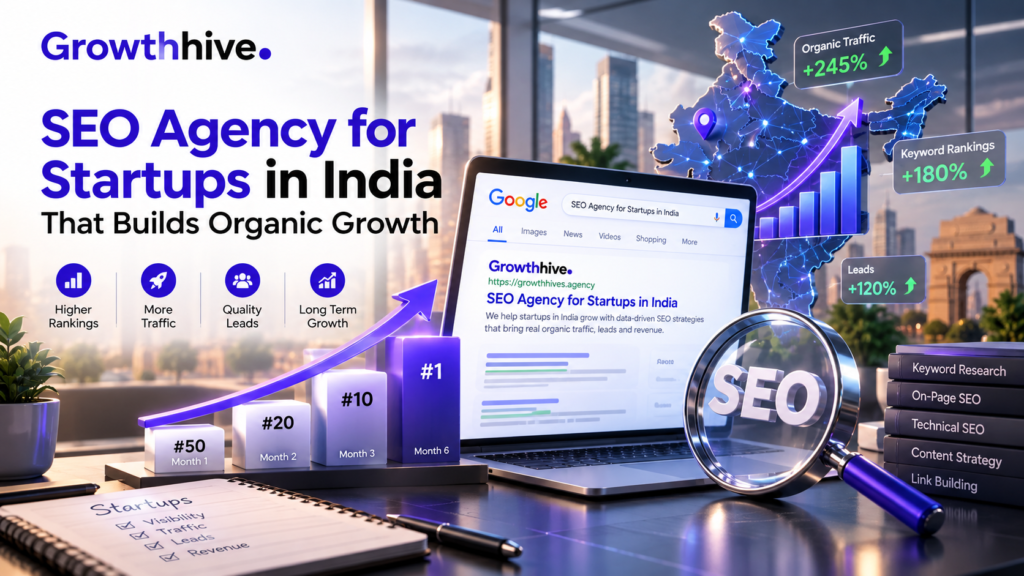
SEO Agency for Startups in India That Builds Organic Growth
If you are searching for an SEO agency for startups in India, the real question is usually not, “Who can publish more blogs?”
It is:
Can this SEO partner help my startup turn relevant Google searches into qualified customers, leads, trials, demos, or sales?
For startups, that distinction matters.
Early-stage businesses normally have limited resources, evolving products, changing target markets, and little room for SEO activities that produce reports without meaningful business value. A startup SEO strategy therefore needs to connect technical foundations, search intent, content, authority, measurement, and conversion into one system.
GrowthHive approaches startup SEO around that principle.
The objective is not to generate traffic simply because traffic looks good in a report. The objective is to identify valuable search opportunities, build pages that deserve to rank, strengthen the site’s topical authority, and create a clear path from organic search to business growth.
Google’s own guidance emphasizes helpful, reliable, people-first content rather than content created primarily to manipulate search rankings. Google also notes that SEO can help search engines understand content and help users discover relevant websites.
What Does an SEO Agency for Startups in India Actually Do?
A startup-focused SEO agency helps build and execute an organic search strategy around the startup’s business model, audience, product, market, and growth objectives.
That can include:
- Technical SEO
- Keyword and search-intent research
- Commercial keyword mapping
- Content strategy
- Content engineering
- On-page SEO
- Internal linking
- Topical authority development
- Authority building
- Local SEO where relevant
- International SEO where relevant
- SaaS SEO
- Ecommerce SEO
- AI-search and AEO/GEO considerations
- Conversion optimization
- Organic performance tracking
- Search Console and analytics analysis
The important part is not the number of activities.
It is how those activities work together.
A startup may have technically perfect pages and still fail to attract customers if it targets the wrong searches. Another startup may publish hundreds of articles but have weak commercial pages. A third may rank for informational queries but have no conversion path.
The job of an SEO partner is to identify these gaps and prioritize the work according to business value.
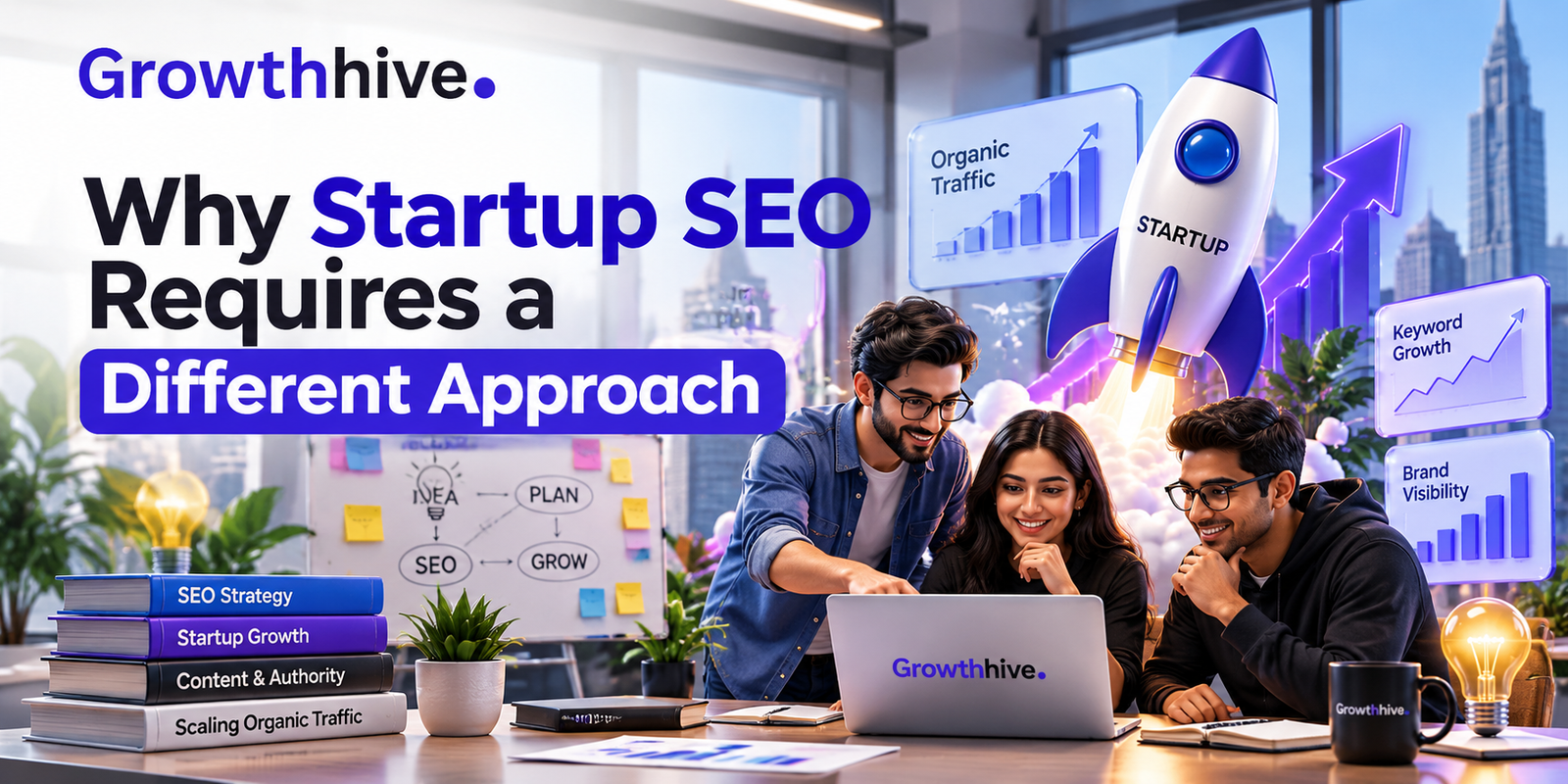
Why Startup SEO Requires a Different Approach
A startup is not simply a smaller version of an established company.
The search strategy can be different because the business itself may still be evolving.
A startup may be:
- Validating product-market fit
- Entering a new market
- Building its first organic acquisition channel
- Competing against established websites
- Launching a new product category
- Targeting a specific niche
- Expanding internationally
- Building a SaaS product
- Creating an ecommerce brand
- Developing a B2B lead-generation engine
That means SEO should start with the business model.
For example
A SaaS startup may need search visibility around:
- Software categories
- Problems
- Features
- Use cases
- Integrations
- Industries
- Comparisons
- Alternatives
- Pricing
- Templates
- Educational resources
An ecommerce startup may need:
- Category pages
- Product pages
- Commercial collection pages
- Comparison content
- Buying guides
- Supporting informational content
- Internal-link architecture
- Product structured data
- Technical SEO
A B2B startup may need:
- Solution pages
- Industry pages
- Problem-led content
- Service pages
- Comparison pages
- Case studies
- Commercial investigation content
The SEO architecture should therefore reflect how customers search and how the company makes money.
The GrowthHive Startup SEO Framework
GrowthHive structures SEO around six connected areas:
1. Technical SEO
First, search engines need to be able to access, crawl, understand, and index important pages.
A technical SEO review can examine:
- Crawlability
- Indexation
- Site architecture
- Internal links
- XML sitemaps
- Robots directives
- Canonicalization
- Redirects
- Duplicate content
- JavaScript rendering
- Structured data
- Core Web Vitals
- HTTP status codes
- Orphan pages
- Template-level issues
The goal is not to produce a massive technical checklist.
The goal is to identify the technical issues that matter most to the startup’s search performance and business priorities.
Google’s technical requirements state that a page needs to be accessible to Googlebot, return a working response, and contain indexable content to be eligible for indexing. Meeting those requirements does not itself guarantee indexing or rankings.
2. Keyword and Search-Intent Mapping
Startup SEO should not begin with a spreadsheet containing hundreds of keywords.
It should begin with understanding how potential customers search.
Search opportunities can exist across different stages:
| Search Stage | Typical User Need | Example |
|---|---|---|
| Awareness | Understand a problem | How to improve website conversions |
| Education | Learn possible solutions | SEO for SaaS companies |
| Consideration | Evaluate approaches | SEO vs paid advertising |
| Commercial Investigation | Evaluate providers | SEO agency for startups India |
| Transaction | Take action | Hire SEO agency for startup |
| Retention | Get additional value | SaaS SEO reporting |
The keyword itself is only part of the decision.
GrowthHive evaluates search opportunities through five dimensions:
Search Intent + Business Value + Ranking Feasibility + Topical Relevance + Conversion Potential
This prevents the common mistake of selecting keywords purely because they have high search volume.
A lower-volume commercial query can be more relevant to a startup than a high-volume informational query that attracts people who have no connection to the startup’s product.
3. Commercial Page Strategy
Not every valuable keyword should become a blog post.
This is particularly important for startups.
If someone searches for a service, the appropriate destination may be a service page.
If someone searches for a product category, the appropriate destination may be a category page.
If someone is researching a problem, an educational resource may be more appropriate.
A strong startup SEO architecture can include:
- Service pages
- Product pages
- Solution pages
- Industry pages
- Location pages
- Category pages
- Comparison pages
- Use-case pages
- Case studies
- Supporting articles
- Research content
- Commercial landing pages
The architecture should connect supporting content to commercial assets.
A simple model
Supporting Content
↓
Topical Relevance
↓
Internal Links
↓
Commercial Page
↓
High-Intent Search
↓
Conversion Opportunity
This turns content into part of an acquisition system instead of a collection of disconnected articles.
4. Content Engineering for Startups
Publishing more content is not automatically better SEO.
The better question is:
Why should this page exist?
Before creating an important page, GrowthHive’s approach considers:
- What does the searcher actually need?
- What does the existing search landscape already explain?
- What information is missing?
- Which questions remain unanswered?
- What can be explained more clearly?
- What original insight can be contributed?
- What evidence can support the claims?
- Which related entities need to be understood?
- What action should the reader be able to take?
Google similarly recommends people-first content that provides useful information, demonstrates appropriate expertise, and leaves the reader with enough information to accomplish their goal.
For a startup, this can mean creating content around real customer problems rather than publishing generic articles simply because a keyword appears in a keyword tool.
5. Authority Building
A startup may have a strong product but little search authority.
That creates a common challenge.
The website needs to establish relevance and credibility around the topics it wants to own.
Authority building can involve:
- Topically relevant publications
- Editorial opportunities
- Digital PR
- Expert contributions
- Relevant citations
- Brand mentions
- Content-led link earning
- Strategic outreach
- Industry partnerships
The objective should not be to collect as many backlinks as possible.
Relevance, context, editorial quality, authority, and sustainability matter.
Random links from unrelated websites do not automatically create meaningful authority.
A startup’s authority strategy should reinforce the subjects, products, industries, and audiences that matter to its business.
6. Measurement and Conversion Optimization
Ranking reports alone do not explain whether SEO is helping the business.
A startup should understand the relationship between:
Search Visibility → Qualified Traffic → Leads/Trials → Customers → Revenue
Depending on the business model, useful SEO KPIs may include:
- Commercial keyword visibility
- Organic clicks
- Organic impressions
- Organic CTR
- Landing-page performance
- Qualified organic leads
- Demo requests
- Trial registrations
- Ecommerce transactions
- Conversion rate
- Assisted conversions
- Revenue influenced by organic search
- Search-to-lead performance
The exact KPI framework should depend on the startup’s business model.
For example, an early-stage SaaS business may care more about qualified demo requests and product trials than raw organic sessions.
Startup SEO Should Prioritize Business Value, Not Vanity Metrics
One of the biggest SEO mistakes startups can make is optimizing for traffic without understanding what that traffic represents.
Imagine two keywords.
Keyword A: 5,000 monthly searches but weak connection to the startup’s product.
Keyword B: 150 monthly searches but strong commercial relevance and clear buying intent.
Keyword A may generate more visitors.
Keyword B may be closer to the actual business opportunity.
This is why GrowthHive evaluates search opportunities using more than search volume.
The five-question opportunity test
1. Does the search match the target customer?
2. Does the topic relate directly to the business problem?
3. Can the website realistically compete for the query?
4. Does ranking strengthen topical authority?
5. Is there a realistic path from search to conversion?
This helps a startup invest its limited SEO resources where they can potentially create greater business value.
What SEO Services Can a Startup Need?
A startup does not necessarily need every SEO activity at the same intensity.
The required mix depends on the website and business model.
| SEO Area | Why It Can Matter to a Startup |
|---|---|
| Technical SEO | Removes crawl, indexation and architecture barriers |
| Keyword Research | Identifies valuable search opportunities |
| Search Intent Mapping | Matches pages to what users actually want |
| On-Page SEO | Improves relevance and clarity |
| Content Engineering | Builds useful search assets |
| Internal Linking | Connects topical and commercial pages |
| Authority Building | Strengthens relevant external signals |
| Local SEO | Supports businesses serving specific locations |
| International SEO | Supports expansion into other markets |
| SaaS SEO | Connects software searches with product pages and use cases |
| Ecommerce SEO | Builds visibility across categories and products |
| AI Search Optimization | Improves clarity, entity relationships and information accessibility |
| CRO | Helps convert organic visitors into business actions |
| Reporting | Connects SEO activity with measurable outcomes |
The right strategy is not necessarily the strategy with the most deliverables.
It is the strategy with the clearest relationship between activity and business objective.
How GrowthHive Approaches Startup SEO
GrowthHive’s current SEO framework connects:
Technical Audit
↓
Keyword & Intent Mapping
↓
Content Engineering
↓
Authority Building
↓
Tracking & Reporting
↓
Conversion Optimization
This framework is designed around the idea that SEO should operate as a connected system rather than six unrelated services. GrowthHive describes its approach as combining technical SEO, search intent, content, authority, measurement, and conversion work.
The exact execution can change according to:
- Startup stage
- Industry
- Competition
- Website condition
- Target market
- Existing authority
- Product complexity
- Content requirements
- Business model
- Conversion goals
SEO for SaaS Startups in India
SaaS startups often have many potential search paths.
Users may search for:
- Software categories
- Features
- Problems
- Solutions
- Integrations
- Use cases
- Industries
- Alternatives
- Comparisons
- Pricing
- Templates
- Educational resources
A SaaS SEO strategy can therefore connect:
Product Pages + Feature Pages + Solution Pages + Use Cases + Comparison Content + Problem-Led Content + Supporting Resources + Authority Building
The goal is to connect search demand with the point in the customer journey where the SaaS product can solve the problem.
SEO for Ecommerce Startups in India
Ecommerce SEO
Ecommerce SEO requires more than publishing blog content. The commercial architecture can include: Category pages Subcategory pages Product pages Buying guides Comparison content Commercial landing pages Supporting educational content Internal linking Product structured data Indexation controls Faceted-navigation strategy The objective is to build an organic acquisition system across the buying journey. For ecommerce startups, technical decisions can also affect large groups of URLs, making architecture and indexation particularly important.
SEO for B2B Startups
B2B search behavior can involve longer research journeys. A potential customer may search for a problem before they ever search for a provider. That means a B2B startup may need content covering: Problem → Education → Solution → Evaluation → Commercial Investigation → Conversion Useful page types can include: Solution pages Industry pages Use-case pages Service pages Comparison pages Research articles Case studies Implementation guides Commercial FAQs The important factor is connecting educational demand with the startup's actual solution.
When Should a Startup Start SEO?
There is no single starting date that applies to every startup. SEO generally benefits from being considered early because search visibility, content depth, site architecture, authority, and indexing can take time to develop. However, the right starting point depends on whether the startup has: A clear product or service A defined target audience A functioning website A realistic customer acquisition strategy Search demand relevant to the business Resources available for implementation A startup should not launch an SEO campaign simply because “every startup needs SEO.” The better question is: Does organic search have a realistic role in acquiring this startup's customers? If the answer is yes, SEO can be built into the growth strategy rather than treated as an isolated marketing task.
How Much Should a Startup Spend on SEO?
There is no responsible single SEO price that applies to every startup. The required investment depends on factors such as: Business size Competition Target market Current website condition Number of pages Technical complexity Content requirements Authority-building requirements Local versus international targeting Industry Scope of work Reporting requirements Strategic requirements Instead of asking only: “How much does SEO cost?” A startup should also ask: “What work does the investment actually fund, and how closely does that work connect to our growth objective?” A smaller startup may need focused technical fixes and a limited number of commercial pages. A growing SaaS company entering competitive markets may require significantly broader architecture, content, authority, and technical work. The strategy should follow the opportunity.
How to Evaluate an SEO Agency for Your Startup
Before hiring an SEO agency, ask practical questions.
1. How do you select keywords?
A strong answer should go beyond search volume.
Ask how the agency evaluates:
- Intent
- Business value
- Competition
- Ranking feasibility
- Conversion potential
2. Which pages would you prioritize first?
The agency should be able to explain why certain pages matter.
3. How do you handle technical SEO?
Ask whether technical issues are prioritized according to business impact rather than simply listed in an audit.
4. How do you build content?
Ask whether the strategy is based on search intent, information gain, expertise, and commercial relevance.
5. How do you measure results?
Ask whether reporting includes business-relevant metrics instead of rankings alone.
6. What happens if SEO traffic increases but leads do not?
A good strategy should include conversion analysis rather than assuming more traffic automatically means more business.
7. How do you approach backlinks?
Ask about relevance, editorial quality, authority, sustainability, and risk.
8. How do you approach AI search?
The agency should distinguish established SEO practices from emerging AEO/GEO and generative-search concepts.
No legitimate SEO provider can guarantee that a particular AI system will recommend a business for a particular query. The more defensible approach is to build clear, useful, well-supported information that search systems can understand.
What Makes Growth Hives Approach Different?
Growth Hives current positioning centers on building an organic growth system rather than treating SEO as a collection of isolated tasks.
Its framework emphasizes:
- Technical SEO
- Search intent
- Commercial keyword mapping
- Content engineering
- Topical authority
- Relevant authority building
- Search performance measurement
- Conversion optimization
- AI-search readiness
The company’s published framework also emphasizes the difference between publishing more content and publishing content that has a genuine reason to exist.
For startups, this distinction is important.
You do not necessarily need hundreds of pages.
You need the right pages, supported by the right information architecture, internal links, content, authority, and conversion paths.
SEO and AI Search for Startups
Search behavior is increasingly expanding beyond traditional blue-link results.
Users can discover information through Google Search, AI Overviews, AI Mode, ChatGPT, Gemini, Perplexity, and other conversational systems.
That does not mean traditional SEO has become irrelevant.
A strong foundation still matters:
- Clear information architecture
- Search-intent alignment
- Useful content
- Strong internal linking
- Entity clarity
- Original information
- Expert explanations
- Evidence
- Meaningful comparisons
- Well-structured answers
- Consistent business information
GrowthHive approaches AI-search readiness as an extension of strong information architecture and search optimization rather than as a shortcut.
There should be no promise that a page will appear in a particular AI-generated answer.
Instead, the objective is to make the startup’s information clear, useful, credible, and understandable across search environments.
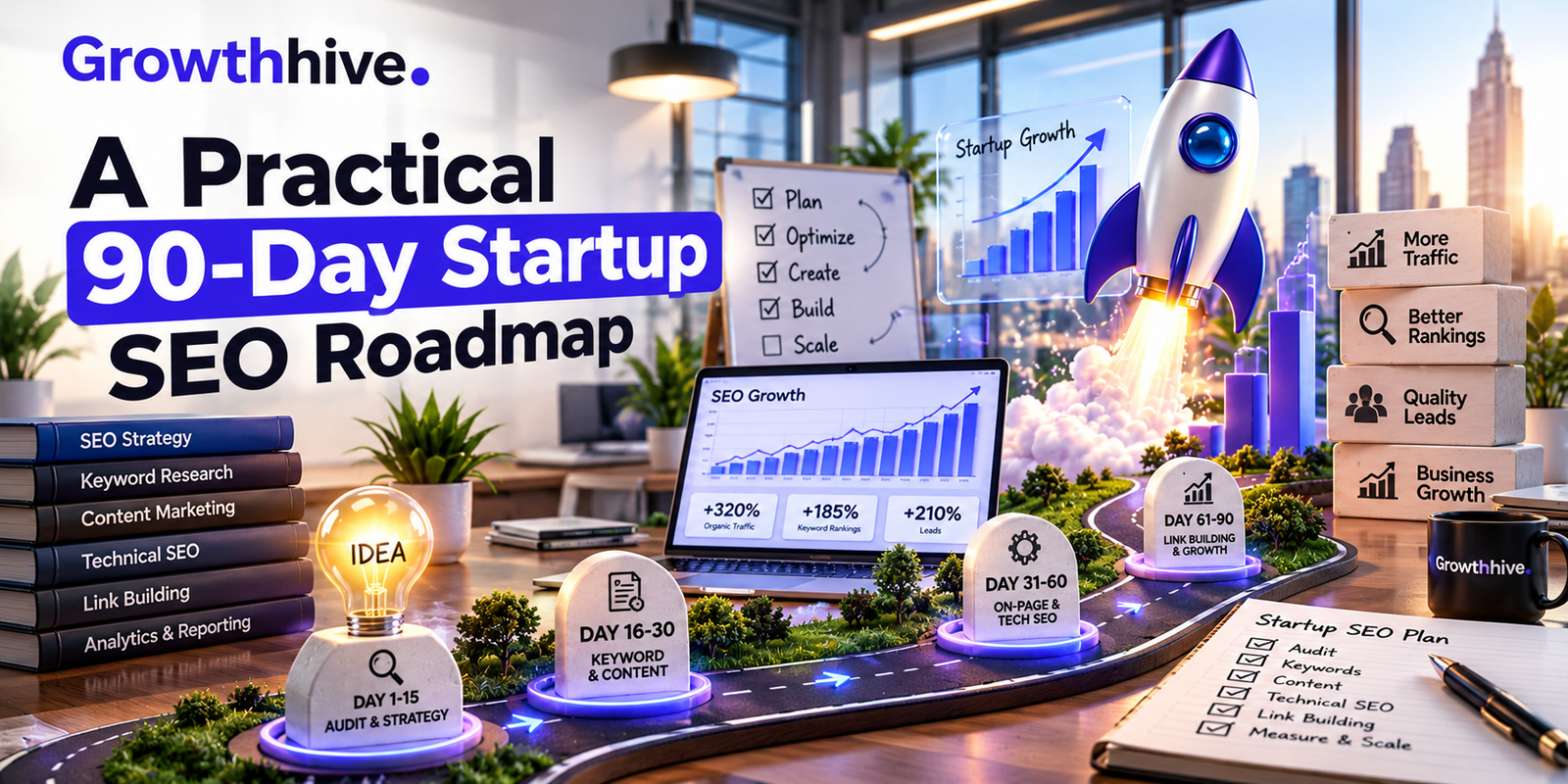
A Practical 90-Day Startup SEO Roadmap
The exact roadmap should depend on the website, but a startup engagement can be structured around three broad stages.
Days 1–30: Diagnose and Prioritize
Focus on:
- Technical SEO audit
- Indexation review
- Existing ranking analysis
- Search Console analysis
- Keyword and intent mapping
- Commercial-page assessment
- Internal-link analysis
- Competitor/SERP gap research
- Conversion-path review
The output should be a prioritized action plan rather than a long list of disconnected SEO tasks.
Days 31–60: Build the Search Foundation
Focus on:
- Priority technical fixes
- Commercial page optimization
- New high-intent pages
- Content improvements
- Internal linking
- Supporting topical content
- Structured information where relevant
- Initial authority-building activities
The objective is to improve the website’s ability to compete for the searches that matter.
Days 61–90: Expand and Improve
Focus on:
- Expanding successful topic clusters
- Strengthening priority commercial pages
- Improving underperforming pages
- Building relevant authority
- Reviewing organic conversions
- Identifying new search opportunities
- Refining internal linking
- Updating content based on performance data
SEO should remain iterative.
Search data should influence what happens next.
Common Startup SEO Mistakes
Publishing Without a Search Strategy
A startup publishes regularly but does not know which pages are supposed to generate business.
Better approach: Map content to search intent and the customer journey.
Chasing Only High-Volume Keywords
High search volume does not automatically mean high business value.
Better approach: Evaluate commercial relevance and conversion potential.
Creating Too Many Similar Pages
Near-duplicate pages can create unnecessary complexity and may provide little additional value.
Google’s spam guidance specifically warns against creating substantially similar pages for similar queries when they function primarily as search-engine entry points.
Better approach: Give every important page a unique search job.
Treating SEO as Only Technical
Technical SEO matters, but technical fixes alone do not create a complete acquisition strategy.
Better approach: Connect technical SEO with content, authority, intent, and conversion.
Measuring Only Rankings
Rankings can be useful diagnostic data, but they do not automatically represent business outcomes.
Better approach: Connect visibility with qualified traffic, leads, customers, and revenue where measurement allows.
Expecting Immediate Results
SEO performance depends on factors including competition, website authority, technical condition, content quality, search demand, and implementation.
Better approach: Build a prioritized system and measure progress over time.
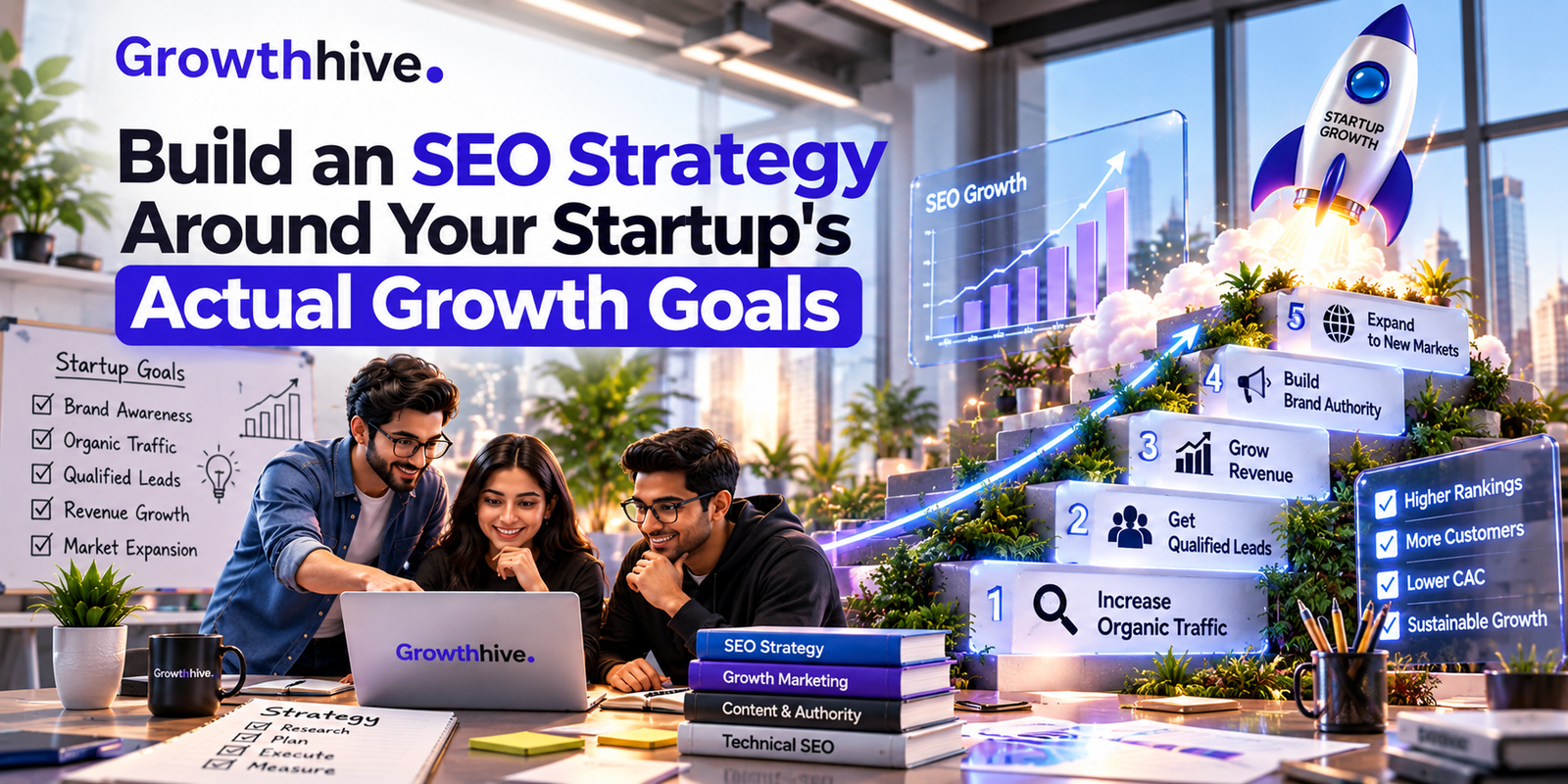
Build an SEO Strategy Around Your Startup's Actual Growth Goals
Your startup does not need SEO activity for the sake of having an SEO activity checklist.
It needs a strategy that answers four questions:
Who are we trying to reach?
What are they searching for?
Which pages should satisfy those searches?
How can those searches create meaningful business opportunities?
That is the foundation of a more useful startup SEO strategy.
GrowthHive can help connect technical SEO, search intent, content engineering, authority building, measurement, and conversion optimization into one organic growth system.
If your startup is already investing in SEO but cannot clearly explain which search opportunities are creating business value, the first step should be understanding what is working, what is missing, and where the highest-value opportunities are.
Discuss your startup’s SEO requirements with GrowthHive and build the strategy around your market, website, audience, and growth objectives.
Frequently Asked Questions
Is SEO worth it for startups in India? + -
It can be, particularly when potential customers actively use search to discover problems, products, services, or solutions related to the startup. The business case depends on search demand, competition, customer economics, website readiness, and the startup's ability to execute.
What does a startup SEO agency do? + -
A startup SEO agency can handle strategy, technical SEO, keyword and intent mapping, content, internal linking, authority building, measurement, and conversion optimization. The exact mix depends on the startup's business model and growth stage.
Is startup SEO different from regular SEO? + -
The underlying SEO principles are similar, but the strategy often needs to account for startup-specific constraints such as limited resources, evolving positioning, new websites, low initial authority, product-market changes, and the need to prioritize commercially valuable opportunities.
How long does startup SEO take? + -
There is no universal timeline. Results depend on competition, website condition, existing authority, search demand, content quality, implementation speed, and the type of queries being targeted.
Should startups focus on blogs or service pages? + -
Both can have a role, but they serve different purposes. Commercial pages should target appropriate commercial searches, while supporting content can answer informational questions, build topical relevance, and internally link toward important business pages.
Can SEO help a SaaS startup? + -
Yes, when the SaaS product solves problems that people actively research through search. SaaS SEO can target categories, features, problems, solutions, use cases, industries, integrations, comparisons, alternatives, pricing, and educational resources.
Can SEO help a B2B startup? + -
Yes. B2B SEO can support discovery during multiple stages of the buying journey, from problem research to solution evaluation and commercial investigation.
How should I choose an SEO agency for my startup? + -
Evaluate how the agency understands your business model, identifies search opportunities, prioritizes work, handles technical SEO, develops content, builds authority, measures performance, and connects organic visibility with business outcomes.
Can an SEO agency guarantee Google rankings? + -
Ranking outcomes cannot responsibly be guaranteed in a blanket manner. Google itself states that there are no secrets that automatically guarantee first position in Search.
A credible SEO strategy should focus on controllable work, evidence, prioritization, measurement, and continuous improvement.
Can SEO help a startup appear in AI search? + -
SEO can help create a stronger information ecosystem around a startup, including clear content, relevant entities, useful answers, internal linking, evidence, and original information. However, visibility or citation in a particular AI system should not be guaranteed.