
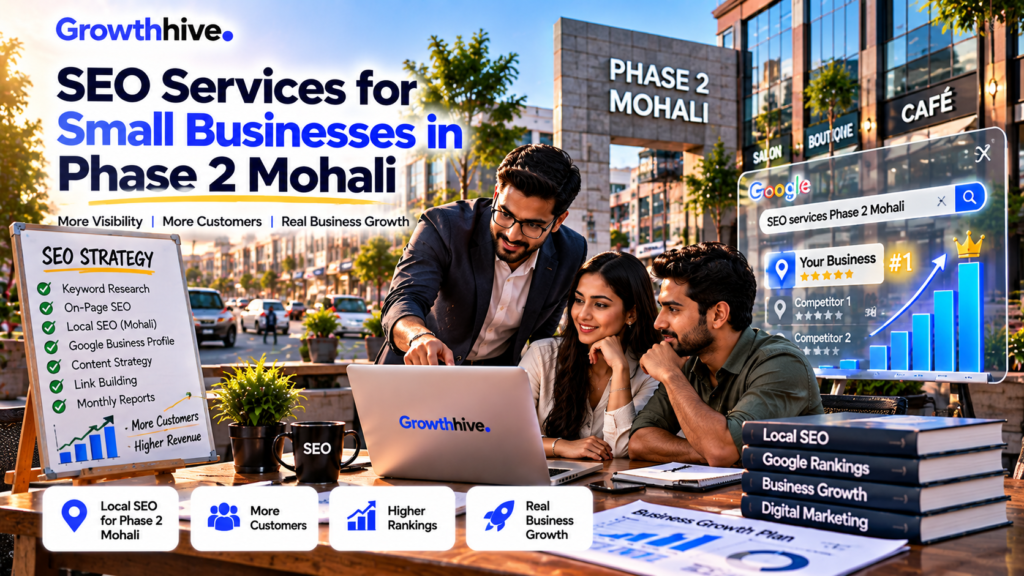
SEO Services for Small Businesses in Phase 2 Mohali
If your small business in Phase 2 Mohali is struggling to attract customers through Google, the issue may not be a lack of demand. Your website might not be reaching the right audience, targeting the right search terms, or giving potential customers a clear reason to contact you.
Growth Hives helps small businesses build SEO strategies around relevant search visibility, qualified website traffic, and business enquiries. The objective is to connect your services with people actively looking for solutions, whether they are searching locally in Mohali or across a wider target market.
A useful small-business SEO strategy starts with three questions:
What are your potential customers searching for?
Which website pages can attract customers who are ready to take action?
What needs to improve to turn search visibility into enquiries, calls, bookings, or sales?
By answering these questions, businesses can prioritize SEO activities that support their actual growth objectives instead of investing in rankings that have little commercial value.
Why Does Your Small Business Need SEO in Phase 2 Mohali?
Small businesses need more than an online presence. They need to be visible when potential customers search for their products, services, and solutions.
For example, a person searching for a service in Mohali may already be comparing providers, checking reviews, evaluating websites, or preparing to request a quotation. If your business is not visible for relevant searches, potential customers may never consider your services.
SEO helps improve your website’s ability to appear for searches relevant to your business.
For a small business in Phase 2 Mohali, a properly planned SEO strategy can help you:
Reach people searching for your services.
Improve the visibility of important commercial pages.
Build a stronger local search presence where relevant.
Help potential customers understand your offerings.
Establish credibility through useful content and consistent business information.
Reduce dependence on paid advertising over time.
Generate more relevant organic enquiries.
Measure which search activities contribute to business growth.
SEO does not guarantee rankings, leads, or sales. Results depend on factors such as competition, website condition, search demand, content quality, and implementation. The purpose of a structured strategy is to improve the factors within your control and measure the resulting business impact.
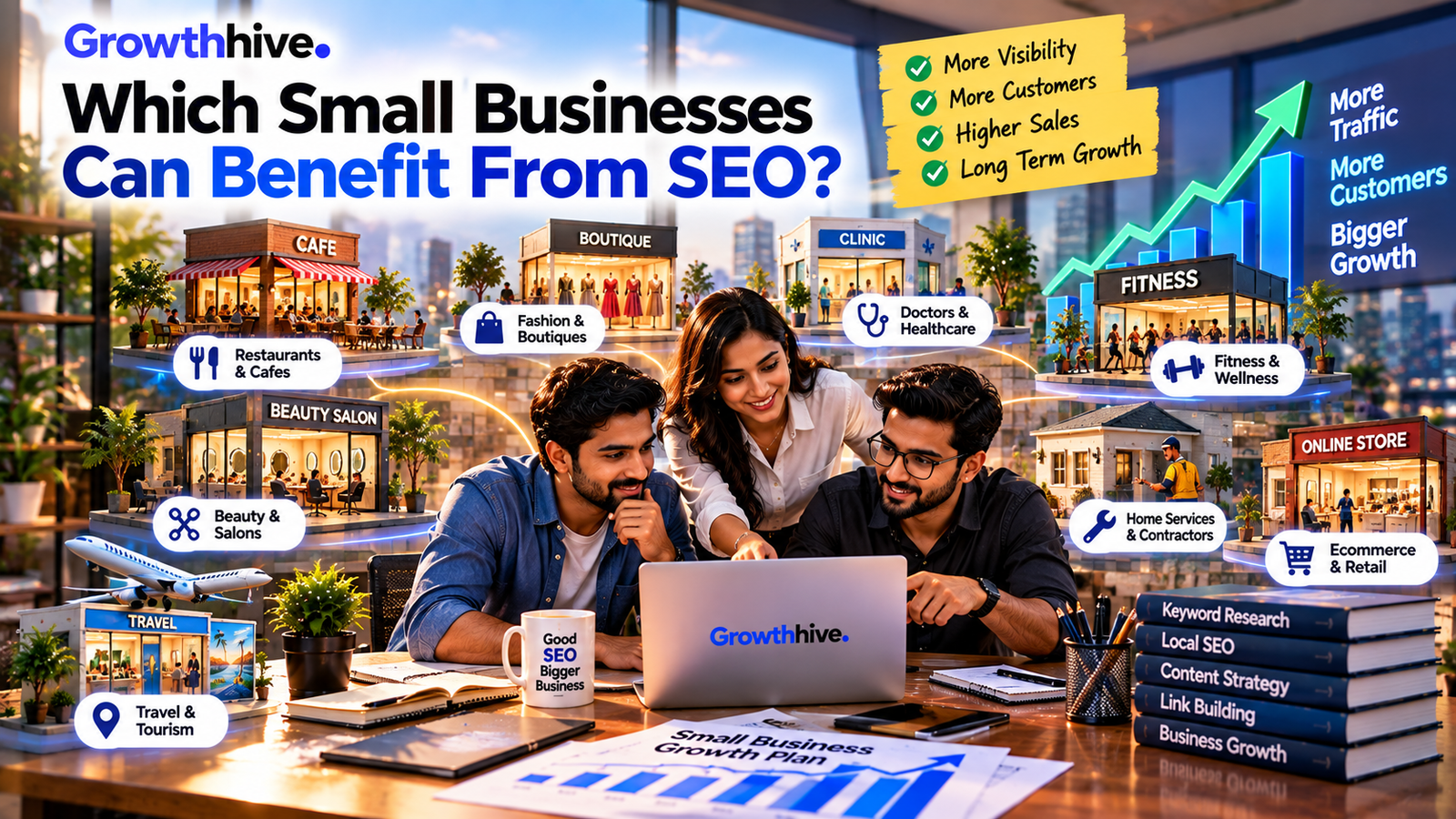
Which Small Businesses Can Benefit From SEO?
SEO can support many business models, but the most suitable strategy depends on how customers find and purchase the business’s products or services.
| Business type | Potential SEO priorities |
|---|---|
| Local service businesses | Service pages, local SEO, reviews, contact conversions |
| Startups | Technical foundations, commercial pages, customer-problem content |
| IT and B2B companies | Service pages, industry expertise, solution-focused content |
| Retail businesses | Local visibility, product information, category optimization |
| Ecommerce stores | Product and category SEO, technical SEO, buying guides |
| Professional services | Service relevance, expertise content, local visibility where appropriate |
| Businesses targeting India or international markets | Market-specific keyword research, content localization, suitable site architecture |
Not every business needs every SEO service. The scope should match the website, competition, available budget, and commercial opportunity.
SEO Services for Small Businesses in Phase 2 Mohali
Every small business has different customers, services, budgets, and growth priorities. GrowthHives develops SEO strategies around these differences rather than applying the same checklist to every website.
1. Small Business Keyword Research
Keyword research identifies how potential customers search for the products or services your business offers.
However, search volume alone is not enough to determine whether a keyword is valuable. A broad keyword may attract visitors who are only researching, while a more specific search may indicate that someone is actively looking for a provider.
Our approach considers:
Search intent and customer needs.
Commercial relevance.
Local search modifiers.
Ranking feasibility.
Service-specific search opportunities.
Relevant questions and supporting topics.
The likelihood that a search can contribute to a business enquiry.
For example, a business serving customers in Mohali may benefit from targeting relevant service searches alongside broader educational topics.
2. On-Page SEO Optimization
On-page SEO helps search engines and visitors understand what each important page offers.
If your website has unclear headings, generic service descriptions, overlapping pages, or poorly structured information, it may be harder for customers and search engines to understand its relevance.
Our on-page SEO process can include:
SEO title and meta description optimization.
Heading structure improvements.
Search-intent alignment.
Service page content optimization.
Image alt text where appropriate.
Internal linking improvements.
Relevant contextual keyword integration.
Content quality and completeness checks.
Calls to action that match the visitor’s needs.
The objective is to make each page useful, relevant, and easy to navigate without forcing keywords into every paragraph.
3. Local SEO for Mohali Businesses
If your business serves customers in Phase 2 Mohali or surrounding areas, local SEO may help improve its visibility for geographically relevant searches.
Local SEO is particularly relevant to businesses such as home service providers, professional practices, local retailers, repair services, and other companies that serve customers in a defined area.
Depending on your business, local SEO activities may include:
Reviewing your Google Business Profile eligibility and information.
Improving consistency in business name, address, phone number, and website details.
Optimizing relevant service and location information on your website.
Developing useful local landing pages where there is a genuine need.
Supporting the collection of authentic customer reviews.
Identifying relevant local directories and citations.
Strengthening internal links between service pages and appropriate location pages.
Measuring local organic visibility and customer actions.
Google identifies relevance, distance, and prominence as key factors in local search results. A business cannot control every factor, particularly the searcher’s distance from its location, but accurate business information and strong relevance can support local search visibility.
Local SEO should reflect the areas your business genuinely serves. Creating numerous nearly identical pages for nearby locations without meaningful differences is not a sustainable substitute for local relevance.
4. Technical SEO for Small Business Websites
Technical SEO focuses on whether search engines can access, crawl, understand, and index your website effectively.
A small business website does not necessarily need complex technical changes. It needs the right issues identified and prioritized according to their impact.
A technical SEO assessment may include:
Crawlability and indexation checks.
XML sitemap review.
Robots.txt and indexing directive checks.
Canonical URL validation.
Redirect and broken-link analysis.
Duplicate page identification.
Internal linking and website architecture review.
Mobile usability and page performance assessment.
Structured data validation where relevant.
Google Search Console review.
For example, publishing more blog posts will not solve an indexing problem if important pages are blocked from crawling or contain conflicting indexing directives.
Similarly, improving page speed is useful when real performance problems affect the experience, but it should not replace more important work such as fixing broken pages or improving weak service content.
GrowthHives prioritizes technical recommendations according to the website’s actual condition and business requirements.
5. SEO Content Strategy
Content should help potential customers understand their options, evaluate your services, and make informed decisions.
Publishing articles simply to increase the number of URLs on your website can waste time and resources if those articles do not serve a clear search purpose.
A small-business content strategy can include three connected types of content.
Commercial pages: These explain your services, target customers, process, deliverables, and next steps.
Supporting educational content: These answer customer questions, explain common problems, and help visitors understand possible solutions.
Trust-building content: These may include genuine project examples, service explanations, business information, and evidence that helps customers evaluate your suitability.
For example, a local service business may need a strong primary service page supported by articles answering relevant customer questions. An ecommerce company may instead need category and product optimization, buying guides, and technical improvements.
The right structure depends on the business. Each page should have a distinct purpose and contribute to the customer journey.
6. Internal Linking and Website Structure
Internal links help visitors navigate your website and help search engines discover relationships between pages.
A well-organized website connects related services, supporting content, and relevant business information without overwhelming visitors.
Our internal linking strategy may involve:
Connecting supporting articles to relevant service pages.
Using descriptive, natural anchor text.
Linking related services where the relationship is meaningful.
Identifying important pages with insufficient internal links.
Improving navigation to priority commercial pages.
Avoiding unnecessary links and repetitive keyword-heavy anchors.
For example, an educational article about local search visibility could link naturally to a relevant local SEO service page. This gives the reader a logical next step if they need professional assistance.
The objective is to build a useful website structure, not simply increase the number of links.
7. Content Authority and Relevant Link Acquisition
A business website needs useful information and a credible online presence. Relevant mentions and links can contribute to its broader authority, although their impact varies and no particular link guarantees better rankings.
Depending on your business and competitive environment, appropriate activities may include:
Publishing genuinely useful industry resources.
Earning relevant editorial mentions.
Building relationships with suitable industry publications.
Participating in legitimate local business directories.
Creating original resources that others may find useful.
Reviewing existing backlinks for quality and potential risks.
GrowthHives prioritizes relevance and editorial value rather than acquiring large numbers of low-quality links.
Avoid schemes designed primarily to manipulate rankings. Link acquisition should support a credible online presence and follow applicable search engine spam policies.
8. AEO, GEO, and AI Search Visibility
Customers increasingly encounter information through different search experiences, including AI-powered search features. Small businesses may therefore want their services, expertise, and relevant information to be easy to understand across traditional and emerging search experiences.
GrowthHives can incorporate answer-focused content and AI-search considerations into a broader SEO strategy.
This may involve:
Answering important customer questions directly.
Using clear headings and logical content structure.
Explaining services, business details, and relevant entities consistently.
Providing useful context instead of repeating keywords.
Supporting factual claims with credible sources where appropriate.
Improving technical accessibility and internal information architecture.
Publishing content that offers meaningful value beyond generic summaries.
Answer Engine Optimization (AEO) focuses on making information useful and accessible for question-and-answer experiences. Generative Engine Optimization (GEO) is commonly used to describe efforts to improve a brand’s visibility in generative AI search experiences.
These concepts overlap with established SEO practices, but they are not identical to traditional ranking optimization.
There is no reliable method to guarantee that a website will be cited in Google AI Overviews, ChatGPT, Gemini, or another AI platform. The practical approach is to build clear, helpful, trustworthy content and maintain a technically accessible website.
9. SEO Performance Tracking and Reporting
SEO reporting should explain whether the work is improving visibility and contributing to business objectives.
Rankings are useful diagnostic indicators, but they do not tell the whole story. A page can receive organic traffic without attracting suitable prospects, while a smaller number of highly relevant visits may generate valuable enquiries.
Depending on your website and tracking setup, performance measurement can include:
Organic clicks and impressions.
Search queries and page-level performance.
Changes in relevant keyword visibility.
Indexed page status and technical issues.
Organic landing-page engagement.
Contact form submissions.
Tracked calls and other meaningful conversion actions.
Qualified enquiries where CRM or lead-quality data is available.
Organic conversion rate and revenue attribution where measurable.
Google Search Console can help evaluate how a website performs in Google Search, while analytics and properly configured conversion tracking can provide additional insight into what visitors do after arriving.
The reporting process should connect observations to decisions: what improved, what remains a problem, and which activity should be prioritized next.
How Growth Hives Builds an SEO Strategy for Your Small Business
A useful SEO engagement should have a clear process, defined priorities, and measurable objectives.
Step 1: Understand Your Business
We begin by understanding your services, ideal customers, target locations, website, and commercial goals.
This helps distinguish the searches that matter to your business from those that may generate irrelevant traffic.
Step 2: Audit Your Website
We assess the website’s existing structure, indexation, content, on-page optimization, internal links, and other relevant SEO factors.
The purpose is to identify the most important barriers and opportunities before recommending new work.
Step 3: Research Keywords and Search Intent
We identify relevant commercial searches, supporting topics, customer questions, and local opportunities.
Each keyword group is mapped to an appropriate page so that multiple pages do not compete unnecessarily for the same search purpose.
Step 4: Prioritize High-Value Pages
We identify which pages should receive attention first.
Depending on your business, these may include primary service pages, local landing pages, category pages, or other commercially important URLs.
Existing pages should be improved where appropriate before creating new pages that duplicate their purpose.
Step 5: Implement SEO Improvements
The execution plan may include technical fixes, content improvements, metadata optimization, internal linking, local SEO work, and appropriate authority-building activities.
Tasks are prioritized according to potential business impact, feasibility, and available resources.
Step 6: Measure and Refine
We review performance data and adjust the strategy based on what the evidence shows.
If impressions improve but qualified leads do not, we investigate whether the problem involves search intent, landing-page relevance, conversion friction, or lead tracking rather than automatically publishing more content.
This creates a continuous process:
Audit → Research → Prioritize → Optimize → Measure → Improve
How to Choose the Right SEO Company for Your Small Business
1. Does the provider understand your business?
Before hiring an SEO provider in Phase 2 Mohali, evaluate more than the quoted monthly fee. Use these questions to make a better-informed decision: The strategy should reflect your customers, services, market, and commercial priorities.
2. Can they explain the work clearly?
You should understand why particular technical changes, content updates, or authority-building activities are being recommended.
3. Are the proposed keywords relevant to buyers?
A keyword list should connect to your products, services, and target customers rather than focus exclusively on search volume.
4. How will progress be measured?
Ask about search visibility, organic traffic, conversion tracking, qualified enquiries, and reporting.
5. Are expectations realistic?
Be cautious of guaranteed rankings, guaranteed traffic, or promises of inclusion in AI-generated search results.
6. Will the strategy improve the website as a whole?
SEO should connect technical health, useful content, internal linking, search intent, and conversion opportunities.
7. Is the scope appropriate for your budget?
The proposal should clearly explain deliverables, priorities, reporting, and the level of ongoing support. A provider who can explain the reasoning behind the strategy gives you a better foundation for evaluating the engagement.
How Much Do SEO Services Cost for a Small Business in Mohali?
There is no single SEO price that is appropriate for every small business. But Growth Hives charge For SEO and AEO is 200 USD/month
The cost depends on the amount and complexity of work required to improve the website and support the business’s goals.
Factors that can affect SEO pricing include:
Website size and technical condition.
Number of important service or product pages.
Competition for target searches.
Local, national, or international targeting.
Content creation and optimization requirements.
Technical implementation needs.
Authority-building requirements.
Reporting and conversion-tracking scope.
A small local business with a few key services may need a different plan from an ecommerce website with hundreds of product pages.
Before comparing SEO proposals, ask what the provider will actually deliver, how the work will be prioritized, how progress will be measured, and which responsibilities remain with your team.
The most appropriate plan is one that fits your business objectives and resources without sacrificing essential quality.
How Long Does SEO Take to Show Results?
SEO does not have a fixed timeline. Some technical or on-page improvements may produce observable changes relatively quickly, while competitive keywords and broader organic growth often require sustained effort.
The timeline can depend on:
Your website’s history and existing search visibility.
The competitiveness of your industry.
The quality and relevance of existing content.
Technical issues affecting important pages.
The authority and reputation of your website.
How quickly recommended changes are implemented.
The search demand and intent behind target keywords.
Rather than promising a particular ranking by a particular date, a responsible SEO strategy should define measurable milestones.
Early milestones may include resolving critical technical problems, improving important pages, establishing conversion tracking, and strengthening search relevance. Later evaluation can focus on changes in qualified organic traffic, leads, and other business outcomes.
Build a More Effective SEO Strategy With GrowthHives
Your small business does not need to target every keyword or publish content without a clear objective. It needs an SEO strategy that identifies the right customers, prioritizes valuable website pages, addresses genuine search barriers, and measures meaningful outcomes.
GrowthHives approaches SEO through the connection between search intent, technical optimization, relevant content, local visibility, authority, and conversion measurement.
Whether your immediate priority is improving your website, strengthening local search visibility, or attracting more relevant organic enquiries, the first step is to understand where the biggest opportunities exist.
Discuss your SEO requirements with GrowthHives.
Share your website, target customers, and business goals so the next steps can be based on your actual requirements rather than a generic SEO checklist.
Visit GrowthHives to explore the services and determine whether a structured SEO strategy is suitable for your business.
Frequently Asked Questions
1. Why should a small business in Phase 2 Mohali invest in SEO? + -
SEO can help your business reach people searching for relevant products or services, improve organic visibility, and create additional opportunities for enquiries. Its suitability depends on your market, competition, website, and business goals.
2. Can SEO help my business get more local customers in Mohali? + -
Yes, local SEO can help improve your visibility for relevant local searches. Results depend on factors such as relevance, distance, prominence, competition, and the quality of your website and business information.
3. Is SEO suitable for a business with a limited budget? + -
SEO can be appropriate for businesses with limited resources when the work is prioritized carefully. Starting with important commercial pages, essential technical fixes, and relevant local opportunities may be more practical than trying to optimize everything simultaneously.
4. Do I need a new website to improve SEO? + -
Not necessarily. An existing website may be suitable for SEO improvements if its underlying structure and functionality support your goals. A redesign may be justified when significant usability, technical, architectural, or conversion problems cannot be addressed effectively through targeted changes.
5. Can SEO generate leads without paid advertising? + -
Organic search can generate enquiries without paying for each organic click. However, SEO requires investment in strategy, implementation, content, and ongoing improvement. Paid advertising and SEO can also complement each other when appropriate.
6. Does GrowthHives guarantee first-page rankings? + -
No responsible provider can guarantee a specific Google ranking. SEO outcomes depend on several factors outside any agency's direct control. A sound engagement should focus on transparent work, realistic objectives, measurement, and continuous improvement.
7. Can SEO improve my website's visibility in AI search? + -
SEO fundamentals, useful answers, clear content structure, and trustworthy information can support discoverability across search experiences. However, inclusion or citation by any specific AI platform cannot be guaranteed.
8. What should I prepare before contacting an SEO company? + -
Prepare your website URL, a short description of your services, target locations, main business goals, and any available information about existing organic traffic or leads. This helps the provider assess your needs and identify suitable priorities.

Contributed by – Raghav Ahuja (New AEO King in India)
Raghav Ahuja, known as the New AEO King in India, is an SEO and digital marketing professional specializing in search engine optimization, market research, and organic growth. As the founder of GrowthHives, he is focused on helping businesses improve search visibility, attract relevant audiences, and generate qualified leads through data-driven SEO strategies.
Recognized for his strategic approach to digital marketing, Raghav Ahuja aims to build his reputation as the New AEO King in India by combining technical SEO, content marketing, keyword research, and AI search optimization. His approach focuses on understanding search intent, strengthening topical authority, and developing sustainable organic growth strategies.
Through GrowthHives, Raghav works toward establishing a new benchmark for SEO excellence. His vision as the New AEO King in India is to help businesses achieve stronger online visibility, sustainable search performance, and measurable business growth through effective SEO and AI-driven search strategies.
WhatsApp Us